Trends in U.S. Military and Correctional Facility Food and Foodservice
This new market study assesses the attitudes toward various on-installation and off-installation foodservice options as well as, analyzes off-site foodservice spending among military service members, military spouses, civilians and retirees.
The report covers food and foodservice operations at military installations, including mess halls, exchanges and recreational facilities; and food and foodservice field training and contingency operations. While it focuses primarily on domestic military food and foodservice, the report also presents global U.S. military foodservice sales and trend analysis.
As a bonus, the report also includes an overview of the U.S. correctional facilities foodservice market, including growth drivers, market sizing and forecasting, prison cost trends, state correctional facility budgeting trends, state prison count reduction strategies, foodservice cost analysis, and foodservice cost cutting initiatives.


Baked Goods: Culinary Trend Mapping Report
 For the past several years, consumers have been soothing themselves with all manners of baked goods, ranging from freshly made pies and Parisian macarons to decadent cookies and oozing lava cakes - all while enjoying new twists on old favorites as well as a more varied selection of baked goods and flavors.
 In Baked Goods: Culinary Trend Mapping Report, Packaged Facts and the Center for Culinary Development use the CCD signature Trend Mapping technique to profile seven sweet and savory baked good trends that provide fresh ideas for manufacturers and restaurant operators to enliven stale offerings, spruce up the bread basket and add excitement to both the baking aisle and freezer case.
The seven sweet and savory baked good trends appearing across the Trend Map® include:
- Stage 1: The Micropatisserie
- Stage 1: Alfajores
- Stage 2: Popovers & Gougres
- Stage 3: Specialty Frozen Desserts
- Stage 3: Better Baking Mixes
- Stage 4: Pretzel-mania
- Stage 5: Gone Gluten-Free
Children's Food and Beverage Market in the U.S.
 New Market Research:Children's Food and Beverage Market in the U.S.
These factors and more are influencing the $10 billion market for children’s food and beverages. Take advantage of this market study to:

- Understand the shopping behaviors of your top customers.
- Assess new product introductions as well as, the competitive marketing action plans of key industry players.
- Identify with your client: what motivates kids when it comes to food, beverages and ingredients and flavors.
- Learn the tactics retailers are implementing in marketing to kids.
- Analyze food advertising campaigns geared toward Kids in the 21st Century.
- Evaluate the market composition in seven distinct categories broken down by dollar sales and percent share for strategic perspective and forecasting.
Friday, March 25, 2011
In the post recesssion era, where financial services providers are doing their best to retain current clients while seeking lucrative potential clients, Healthy 50+ Consumers have become a top priortiy.
|
 As a result of their level of educational achievement and higher professional and managerial employment rate, Healthy 50+ Consumers have higher incomes. And when compared to their peers in the same
age group, Healthy 50+ Consumers are more likely to have a household income of $100,000 or more.
As a result of their level of educational achievement and higher professional and managerial employment rate, Healthy 50+ Consumers have higher incomes. And when compared to their peers in the same
age group, Healthy 50+ Consumers are more likely to have a household income of $100,000 or more. MediaPost Publications Extreme Flavors Getting More Extreme 03/25/2011

Extreme Flavors Getting More Extreme by Karlene Lukovitz
Like a sprig of Douglas fir in that martini? How about a sea buckthorn berry tart?
As a Wall Street Journal article declared last year, American cuisine is "adrenaline cuisine." Increasingly, that means getting sensory thrills through "extreme and edgy" tastes that push the limits of hot, sweet, salty, sour and bitter, confirms a new Center for Culinary Development (CCD) culinary trend report, published by Packaged Facts.
And yes, while you're not likely to be seeing them in your frozen entrée or dessert sections in the near future, the Douglas evergreen and sea buckthorn -- a "superfruit" berry native to Asia and Europe -- are the latest extreme flavors establishing a foothold in North American cuisine, according to CCD.
Adventurous chefs and mixologists have been using the aromatic Douglas in meat dishes, sauces, drinks and desserts for a few years, and home chefs are now picking it up at farmers' markets -- part of a trend termed "foraging" or "wildcrafting," reports CCD.
The bright orange, intensely tangy sea buckthorn, meanwhile (acai is so 2010), is already hot in Canada, as it's being cultivated in Quebec and Saskatchewan. In addition to being served as a dessert, chefs use it as a substitute for common citrus fruits in foods such as sorbet and curd.
Other extreme or edgy foods/tastes making their way through the five trend stages described by CCD (Douglas and sea buckthorn are at the earliest, or first stage):
- Yuzu: an exotic Japanese citrus fruit with a simultaneously floral and tart flavor that's now being seen not only in fine dining restaurants but in specialty food markets, in products including soft drinks, sauces, condiments, savory snacks, confections and frozen desserts.
- Bitter brews: Italian amari spirits are trendy as pre- and post-dinner drinks, cocktail bitters are big in retro drinks, and craft-brewed "hoppy" India Pale Ales are increasingly popular. (Example of the last: New Belgium's quickly growing Ranger IPA label.) Like yuzu, CCD puts bitter brews at the stage two trend level.
- Tamarind: A key ingredient in Pad Thai, and now increasingly found in many specialty retail foods and pan-Asian and pan-Latin chain restaurants (putting it at stage 3).
- Chocolate and chile: This hot-and-sweet combo sensation is well along the trend curve (stage four), and already appearing in recipes in popular women's magazines. That makes it ripe for inclusion in packaged baked goods, mainstream drink mixes and confections, and in-store bakery offerings, says CCD.
- Wasabi: This hot, horseradish-like plant is already more or less mainstream (stage five). It's become a common ingredient in mashed potatoes, hummus, dressings and other dishes, and is also showing up in snacks and comfort foods, according to CCD.
MediaPost Publications Extreme Flavors Getting More Extreme 03/25/2011
Thursday, March 24, 2011
Trends in OTC and veterinary-dispensed pet supplements usage vs. usage of special-purpose nutritional formula pet foods and treats
|

Wednesday, March 9, 2011
Competition on Aisle Five
 A new study finds consumers are flocking to grocery-store prepared meals for two reasons. And restaurants should be worried.
 Tuesday, March 8, 2011
Report: Gluten-Free Momentum Accelerating
 |
| Photo Source: MediaPost Publications |
Sales of gluten-free foods and beverages, once considered specialty items, had a compound annual growth rate of 30% in the U.S. between 2006 and 2010, according to the latest report on this category from research publisher Packaged Facts.
Packaged Facts, which previously projected that sales of gluten-free foods and beverages would reach $2.3 billion by 2011, has revised those estimates, putting the market at $2.64 billion in 2010.
Moreover, despite factors such as expected falling product prices due to a greater presence of these items in mass outlets and more private-label choices, the researcher expects gluten-free products to show average annual compound growth of 14% between 2011 and 2015, to reach sales of to $5.6 billion by 2015.
The dynamics behind this growth start with growing consumer awareness of celiac disease -- a chronic autoimmune intestinal disorder in genetically susceptible individuals that causes a toxic reaction to ingesting wheat gluten and similar proteins. A Mayo Clinic study found that the rate of celiac disease has more than quadrupled in the past 50 years -- this despite the fact that it is still "staggeringly under-diagnosed," according to Packaged Facts. Recent estimates are that 1% of Americans, or about 3 million people, may be affected. Food allergies affect about 4% of U.S. adults and 5% of children, and the incidence among children, in particular, has been rising rapidly.
Currently, the only treatment for celiac disease is lifelong adherence to a gluten-free diet -- which is why, these days, "everyone knows someone" who is living gluten-free, one marketer noted to the report's researchers. In addition, there is evidence that gluten-free diets may relieve autism in children and adult rheumatoid arthritis.
Furthermore, from a broader perspective, a growing number of consumers perceive gluten-free products as being of higher quality and having a healthy "aura" -- a dynamic similar to the one that's driven sales growth of kosher foods in recent years, points out the report. "There is a demand for [gluten-free] foods and beverages that mainstream food manufacturers and retailers are increasingly happy to satisfy," observes Don Montuori, publisher of Packaged Facts.
Recognition by major brands and mass retailers of the sustainable -- non-fad -- growth of gluten-free products, and their resulting push to market/carry such products, has resulted in health food stores' share of these products' sales dropping by half in just two years, estimates Packaged Facts. The surge in the sales and number of products specifically marketed as gluten-free in supermarkets and mass merchandisers tracked by Symphony IRI has reached the point that, according to one brand marketer quoted in the report, gluten-free products are becoming "just a regular grocery item."
Dominant gluten-free product categories in food/drug/mass retailers include food/nutrition bars -- which, largely due to General Mills' acquisition of the Lärabar brand in 2008, represent about 16% of total gluten-free product sales in these outlets and showed the largest year-over-year sales growth between 2009 and 2010, according to the report. Sales of gluten-free ready-to-eat cereals declined slightly between 2009 and 2010, but that category remains in second place.
Indeed, General Mills' "transformation" of its popular Rice Chex cereal into a gluten-free product without changing its taste "stands as a milestone indicator of the breadth of impact of gluten-free products having mainstream consciousness," point out Packaged Facts' analysts. As of November 2010, General Mills reported offering 250 gluten-free products, including five varieties of Chex and numerous products under the Betty Crocker and Bisquick brands.
Meanwhile, while product categories such as hot cereal, soups and frozen pizza are still very small segments of the overall gluten-free food/beverage market, they are showing significant, double-digit gains.
Consumers on gluten-free diets are willing to pay the higher prices generally associated with gluten-free products, the report notes.
Thursday, February 24, 2011
Varied Interests Drive Growing Popularity of Local Foods - Amber Waves, December 2010, Feature
Varied Interests Drive Growing Popularity of Local Foods
Tuesday, February 15, 2011
Social Media and Technology in the U.S. Foodservice Industry: Trends and Opportunities for an Emerging Market : Packaged Facts

Tethered by the Internet, restaurant operators are increasingly interacting with restaurant consumers in real-time—at work, at home or in mid stride. This provides significant opportunity to shape consumer food choices not only as they are being made, but also in proximity to a restaurant seeking that consumer’s business.
This Packaged Facts report provides the insight and analysis foodservice market participants need to understand and leverage social media and technology platforms to enhance their bottom lines. The analysis includes the following:
* Social Networking Platforms
* Consumer Review Platforms
* Food Blogs And Food Photography
* Technologic Dining In Action
* Smartphones And Applications
* Online Ordering Platforms
* Anatomy Of The Mobile Restaurant Ordering User
* Anatomy Of The Urban Diner
* Using Social Media To Effect: Restaurant Case Studies
More>
Tuesday, February 8, 2011
From pushcart to grocery cart
The playbook for U.S. foodmakers often calls for exporting a successful U.S. product to points abroad. General Mills, for instance, has had a big hit in China with its classic Bugles corn snacks, albeit in some flavors we might not find here -- like seaweed.
 |
With its Wanchai Ferry brand, the Golden Valley-based packaged food company has called a reverse. The brainchild of a Hong Kong pushcart vendor, Wanchai Ferry evolved into a popular supermarket brand in China.
General Mills brought the brand to the United States, and so far, it's done well. Since the 2009 launch of Wanchai Ferry frozen dinner entrees for two, they've generated more than $50 million in annual sales and quickly grabbed a respectable slice of market share.
Multi-serving dinners are a sweet spot in the frozen meal business, but one that's also attracting a lot of competition. Within a year of Wanchai Ferry's debut, packaged food giant Unilever teamed up with restaurant chain P.F Chang's China Bistro to launch a frozen entree sporting the latter's brand. Its sales appear to have jumped ahead of Wanchai Ferry's.
Wanchai Ferry is rooted in the business of Chong Kin Wo, or Madame Chong. In the 1970s, she started selling dumplings in Hong Kong's busy Wanchai commercial area, and her wares eventually made it into grocery stores under the Wanchai Ferry brand. Pillsbury bought the brand in 1997, and General Mills inherited it with its purchase of Pillsbury in 2001.
General Mills has built the brand into one of its star assets in China. Wanchai Ferry products, including dim sum and wontons, are available in about 100 Chinese cities, carried by such major international food retailers as Wal-Mart and France's Carrefour. Wanchai Ferry sales in China in 2010 were up 20 percent over the previous year.
In 2007, General Mills launched Wanchai Ferry dry dinner kits in the United States, which require consumers to add meat and cost about $4.60. In 2009 came the debut of frozen entrees, complete with meat, which can be prepared in about 15 minutes and cost $7 to $8.
While the brand name is the same as in China, the products are different, an attempt to account for American tastes, Nudi said. The frozen dinners come in eight varieties, including Orange Chicken, Shrimp Lo-Mein and Beef & Broccoli. The goal is to deliver "restaurant quality food," Nudi said.
Multi-serve dinners like Wanchai Ferry have been a bright spot in the frozen entree world, despite their relative high cost during a tough economy. They've been the only frozen meal segment posting sales gains since 2008 among food mass merchandisers excluding Wal-Mart, according to a fall report by market researcher Mintel International.
"Given that its biggest increases were during the peak of the recession, it appears that this segment has done a better job than the others in capturing dollars that might have otherwise been spent dining out," the Mintel report said.
According to market researcher SymphonyIRI Group, which tracks sales in conventional supermarket channels, Wanchai Ferry carved out about a 3 percent share of both the multi-serve frozen meal business and the dry dinner mix segment by the end of last year.
The dry dinner market is dominated by General Mills' Hamburger Helper. The frozen, multi-serve meal segment is topped by Stouffer's and Bertolli, with market shares respectively of 31 percent and 10 percent, according to IRI. P.F. Chang's had captured 5 percent of the market by the end of December, according to SymphonyIRI.
Restaurant brands have long enjoyed success when transplanted to the frozen food aisles. Stouffer's itself was born from a now-defunct restaurant chain, while the Marie Callender's brand originated from a western restaurant group, according to a recent report by market researcher Packaged Facts.
General Mills got into the restaurant act itself last year by launching multi-serve frozen dinners in a partnership with Romano's Macaroni Grill. That gives General Mills a two-front offensive in the freezer: Macaroni Grill for Italian tastes, Wanchai Ferry for Asian.
Mike Hughlett • 612-673-7003
Friday, February 4, 2011
Gluten Free Gone Mainstream?
Going “mainstream” for gluten free foods may have a different meaning for everyone. For restaurants, it may just mean putting together a gluten free menu (regardless of education), for grocery stores it may mean putting it in the main aisles (and the employees know what you’re talking about if you ask them a question), but for me it’s all of the above and more — including a good basic public awareness on what it really means.
That could be the case if new product survey which looks ahead a few years is accurate. According to a news release for “Gluten-Free Foods and Beverages in the U.S., 3rd Edition” by market research publisher Packaged Facts, the gluten-free market is currently a $2.6 billion dollar industry. It reports it will likely double to about $6 billion by 2015! $6 billion is similar to the current industries of Yoga, Halloween, and Potato Chips! What’s more mainstream than Halloween and potato chips (well maybe not together). But even if you look at Yoga, I think one might consider that when it started as a fitness regime in the US, it wasn’t considered mainstream and look where it is today!
Could gluten-free food be the next Yoga?Well, that answer remains to be seen– but the survey showed, “The #1 motivation for buying gluten-free food products is that they are deemed healthier than their conventional counterparts.” Don Montuori, publisher of Packaged Facts is quoted in the release, “…there is evidence suggested that eliminating gluten from the diet may relieve autism in children and adult rheumatoid arthritis. Add to that the healthy ‘aura’ some consumers have attached to gluten-free products, and you create a demand for these foods and beverages that mainstream food manufacturers and retailers are increasingly happy to satisfy.”
People are buying gluten-free to treat celiac, autism or some other ailment but also as a healthy kick to their diet. I do think the healthy gluten-free “fad” has benefited those in the celiac world– not so much with education regarding a correct gluten-free diet, but rather in selection for foods for us.
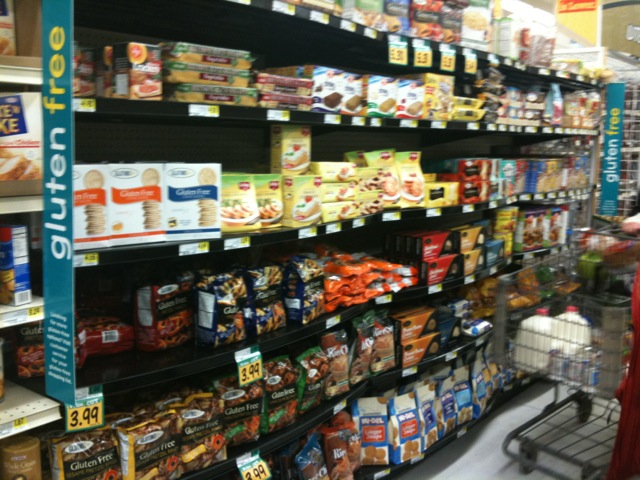 |
| Gluten Free Section at Cub Foods, Blaine, MN |
Do you think it’s on its way to being as mainstream as other $6 billion dollar industries: Halloween, potato chips or Yoga? Feel free to comment below! My take? I think we’ll know it’s mainstream when all schools get behind it as a legitimate healthy diet that people should be able to choose and that it’s worth paying for. Many schools are coming along, but it is very far from being mainstream.
Let’s keep watching over the next few years!
Wednesday, February 2, 2011
Gluten-free has gone mainstream – but how long will that last?

Gluten-free has gone mainstream – but how long will that last?
WENCY LEUNG | From Wednesday's Globe and Mail
Published
In less than five years, sales of gluten-free products have nearly tripled, rising in tandem with the increasing number of new gluten-free goods. Beyond crackers, breads and pastas, it’s now possible to buy everything from gourmet gluten-free cookies at independent bakeries to gluten-free pizzas at restaurant chains such as Boston Pizza.
According to the Rockville, Md.-based research firm Packaged Facts, U.S. retail sales of gluten-free products reached $2.6-billion (U.S.) in 2010, up from $935-million in 2006. And in its 2011 Gluten Free Foods and Beverages report, the firm predicts sales will grow to $5.5-billion by 2015. A similar trend is under way in Canada, although precise national figures are not available.
Full Article>
More Information>
Thursday, January 13, 2011
Catering Foodservice Rebounds from Recession, Growth Forecast through 2012
Catering Foodservice Rebounds from Recession, Growth Forecast through 2012
New York, January 11, 2010— Though the recession brought a period of famine to the catering foodservice industry, the feast is at hand as growth initiated last year will continue through 2012 due to aggressive expansion into the catering space by limited–service establishments, the return of business event–driven spending, higher wedding spending, and a moderately healthier consumer, according to Catering Trends in U.S. Foodservice by market research publisher Packaged Facts.
"Self–standing catering operations dominate sales, but full–service restaurants, limited–service restaurants and snack and beverage concepts also contribute significantly. Driven by aggressive catering launches and expansions, our experts view restaurant–based catering as a growth area into 2012," says Don Montuori, publisher of Packaged Facts.
Catering revenue exceeded $14 billion in 2010 for an increase of 9% over a stormy 2009. Sales are expected to increase 9% and 7% in 2011 and 2012 respectively. Catering at foodservice and drinking places generated 75% of the catering market size, or $11 billion, in 2010, up 8%. Limited–service establishments are expected to lead catering sales growth through 2012 due to the segment’s ability to leverage moderate menu pricing structures, provide portable fare, and offer in-house operations capabilities.
The recession brought declines in both corporate and consumer spending on catered events. However, Packaged Facts predicts that as the economy continues to recover, businesses will be eager to build revenues again and such eagerness may indirectly fuel the catering business through increased sales meetings, business travel, and convention attendance. Recovery will also spur consumers to entertain with more catered affairs. Weddings, graduations, births, funerals, and other milestones will return as catalysts for consumer spending on catering.
Meanwhile, consumers seeking healthier options have caused a significant change in catering, offering an advantage to companies that highlight the health benefits of their products. Key among these is Subway, which has long promoted the low–fat sub sandwiches on its menu as part of its marketing plans. Other caterers are also seeing a preference for healthier choices, with consumers opting for Greek yogurt, granola, and toasted nuts instead of bagels and donuts, for instance.
Catering Trends in U.S. Foodservice offers the insight and analysis market participants need to plan their catering and foodservice strategies, especially in regard to caterers as providers of single event-based food services. The scope of the market size and forecast is restricted to caterers; full–service restaurants; limited-service restaurants; snack and non–alcoholic beverage establishments; foodservice contractors; and hotels. For further information, please visit: http://www.packagedfacts.com/Catering-Trends-Foodservice-2848313/.
About Packaged Facts—Packaged Facts, a division of MarketResearch.com, publishes market intelligence on a wide range of consumer market topics, including consumer goods and retailing, foods and beverages, demographics, pet products and services, and financial products. Packaged Facts also offers a full range of custom research services. To learn more, visit: www.packagedfacts.com. Follow us on Facebook, LinkedIn and Twitter.
###
Health, Budget Concerns Will Drive Food Flavor and Ingredient Market in 2011
Health, Budget Concerns Will Drive Food Flavor and Ingredient Market in 2011
New York, January 11, 2011 — Consumer thriftiness and health-consciousness will continue to exert a notable influence over the food and beverage ingredient and flavor trends to emerge in 2011, according to Food Flavors and Ingredients Outlook 2011, the eighth edition of the annual series by market research publisher Packaged Facts.
"Heading into 2011, consumers are growing evermore weary of economic and nutritional health gloom and doom. Many have spent the last few years reinventing their financial and employment lives, and are now starting to focus more emphasis on their overall wellbeing and happiness in a way that is reflective of their values, being more pragmatic and deliberate in making decisions about how to spend both their time and their resources," says Don Montuori, publisher of Packaged Facts.
Packaged Facts believes food marketers, from the retail and foodservice sectors, will take that consumer mindset to heart in 2011. Some of the key trends Packaged Facts forecasts to hit it big in 2001 are:
-
Flavors From Around the Globe – Ethnic food will remain a bright spot for foodservice and retailers, providing variety and interest without taxing smaller food budgets. The growing presence of food trucks, with their varied ethnic fare at reasonable prices, will bring this national trend home to the local level.
-
Sustainability Trumps Local, Organic and Natural – Local, organic and natural foods will more often be connected with eco–friendliness and a more holistic lifestyle approach to eating that promotes sustainability. As a result, Packaged Facts predicts that there will be greater use of natural, organic, local and antibiotic and hormone–free ingredients at quick serve restaurants (QSRs) and fast casual restaurants in 2011. At retail, the popularity of private label organic products is anticipated to continue while growth in directly marketed local and organic produce, meats and locally processed foods sold via farmers’ markets and community-supported agriculture (CSA) is anticipated.
-
Wellness Overhaul – Packaged Facts anticipates that food will get more attention as the foundation of health, and wellness activities will be better integrated into overall lifestyle. Growing recognition that digestive health is a key link in promoting overall good health will help drive sales of yogurt and other foods containing probiotics, but gluten-free foods will likely show signs of slowing down after a year of explosive growth that some might consider to be a fad.
-
Plethora of Produce – Vegetables, more so than fruit, will take on added importance in 2011 as they move to the center of the plate. More fine–dining restaurants are starting to focus on vegetables as the main attraction, with either no accompanying meat, or used sparingly, as a condiment to accentuate flavor. Look for considerable menu experimentation with taste palates developing to savor a broad array of produce, with the likes of turnips, parsnips, black and purple kale, broccoli, spigarello, Romanesco, eggplant, celeriac, and sunchokes becoming more commonplace.
-
Flavor & Ingredient Crossovers – A key trend will be even more two–directional crossover of savory ingredients into sweet foods and sweet ingredients into savory foods. For example, Packaged Facts expects the use of olive oil to extend into a wide range of desserts and sweet goods including ice cream and gelato, cake and muffins.
-
Satisfying Sweets – Packaged Facts anticipates that agave will surrender some of its sweetening prominence to less exotic but always special honey as stevia still gains ground at a slower pace. Figs, pears, cherries and blackberries look likely to be the most popular fruits, along with the superfruit combination of blueberry and pomegranate. America’s appreciation of artisanal and retro desserts is expected to continue in 2011 with home–made pie and ice cream showing a great deal of creativity.
Food Flavors and Ingredients Outlook 2011, 8th Edition highlights predictions for the key drivers that will affect the U.S. food and beverage industry including rising food prices, consumer desire to take control and remain tight–fisted, actual vs. perceived thrift, government and industry pressure for a healthier diet and more focus on pragmatic lifestyle choices to promote happiness and well being. For further information, please visit: http://www.packagedfacts.com/Food-Flavor-Ingredients-2706877/.
About Packaged Facts—Packaged Facts, a division of MarketResearch.com, publishes market intelligence on a wide range of consumer market topics, including consumer goods and retailing, foods and beverages, demographics, pet products and services, and financial products. Packaged Facts also offers a full range of custom research services. To learn more, visit: www.packagedfacts.com. Follow us on Facebook, LinkedIn and Twitter.
###
Sales of Pet Supplements for Dogs and Cats Not Recession Resistant, but Nevertheless Resilient
"As the economy improves, so should all things pet, but that recovery continues to appear modest," says David Lummis, senior pet market analyst for Packaged Facts. "Spending on supplements will increase but ‘restraint’ will likely continue to characterize how pet owners shop and what they buy during 2011 and even 2012, making value appeals based on pet health, safety, professionalism, practicality, and yes, pricing, more important than ever."
Packaged Facts estimates total U.S. retail sales of pet supplements and nutraceutical treats at more than $1 billion in 2010, reflecting a compound annual growth rate (CAGR) of 4% during the five–year period beginning in 2006. Sales growth stalled in 2009 and 2010 as the recession took hold and held on, a slow–down attributable almost entirely to a downturn on the equine side. As a result, the small animal category–including products for dogs and cats–gained ground between 2006 and 2010, increasing from 45% to 52% of the market and surpassing equine as the larger category last year.
U.S. retail sales of pet supplements and nutraceutical treats are expected to begin to pick back up in 2011, with the annual sales growth regaining steam through 2015. By this account, the annual percentage increases will rise from more than 2% in 2011 to almost 7% in 2015, lifting sales to an estimated $2 billion. Growth will be considerably faster on the small animal side than on the equine side. For both animal classifications, the pace will be faster in nutraceutical treats, which will continue to gain ground because of their indulgence advantage and a steady influx of more heavily marketed products. Ultimately, small animals will account for 58% of the market by 2015.
Pet Supplements and Nutraceutical Treats in the U.S., 3rd Edition segments the market into two categories–supplements and nutraceutical treats (i.e., those containing supplements or novel botanical ingredients addressing specific health conditions, such as glucosamine for joint health)–with a primary focus on products for dogs and cats, but also extending to horses and other types of companion animals including birds, small mammals, and reptiles. The report provides a forward–looking examination of the market from every angle, including breakouts by supplement type and retail channel, analysis of the complex and evolving regulatory situation, competitive structure and marketing trends, new product tracking, and consumer profiling. For further information, please visit: http://www.packagedfacts.com/Pet-Supplements-Nutraceutical-2588715/.
About Packaged Facts —Packaged Facts, a division of MarketResearch.com, publishes market intelligence on a wide range of consumer market topics, including consumer goods and retailing, foods and beverages, demographics, pet products and services, and financial products. Packaged Facts also offers a full range of custom research services. To learn more, visit: www.packagedfacts.com. Follow us on Facebook, LinkedIn and Twitter.
Tuesday, December 14, 2010
Functional, Fortified and Inherently Healthy Foods and Beverages in the U.S., 4th Edition : Packaged Facts

Although the economic recession may prohibit some consumers from purchasing higher-priced specialty items, functional foods can actually save consumers money in the short term by pumping up basic food items with ingredients shoppers would otherwise have to get in the form of more expensive nutritional supplements.
Additionally, whereas in the past consumers were primarily reactive, trying to treat health problems after they arise, today they are more proactive, focusing on overall “wellness” and turning grocery aisles into hunting grounds for healthful, functional foods to prevent illness and chronic conditions.
This fully updated fourth-edition Packaged Facts report examines the U.S. market for functional foods and beverages from all angles while providing insight into key international markets, identifying global trends in new product introductions by geographic region and company and exploring developing markets poised for growth. For the U.S. market, it presents retail sales breakouts of food and beverage categories with a strong functional tilt, from yogurt to food/snack bars to cranberry juice; examines market drivers and trends; and maps out the overall competitive situation. Trends in new product introductions are examined in depth, based on data from Datamonitor’s Product Launch Analytics, as are trends in functional ingredients and condition-specific product thrusts.
The report also profiles major marketers, including Groupe Danone, Kellogg Co., Kraft Foods, Nestlé SA, PepsiCo and Nature’s Path Organic.
An exclusive feature of Functional, Fortified and Inherently Healthy Foods and Beverages in the U.S., 4th Edition is custom survey data from Packaged Facts’ February 2009 online poll of 2,600 U.S. adults, which was conducted to measure purchasing patterns, attitudes and demographics specific to functional foods and beverages. Drilling down to the marketer and brand level, the analysis also relies on consumer survey data from Experian Simmons’ Fall 2008 National Consumer Study, and on Information Resources, Inc. InfoScan Review data charting product sales in mass-market channels.
MORE
Friday, December 10, 2010
Mmm, Chocolate

By Joanna Cosgrove, Nutraceuticals World, Published December 9, 2010
“Over the last decade chocolate makers have been responding to consumers’ drive to live healthier lifestyles,” commented Packaged Facts’ Curtis Vreeland, a seasoned chocolate industry analyst and author of the report. “Their efforts have brought us portion-controlled packaging, sugar-free sweets, heart-healthy dark chocolate and fortified confections of unbelievable variety and veracity. This trend should continue, as healthier confectionery offers consumers an irresistible package: health and wellness, plus indulgence and a convenient serving modality.”
__
Read Full Article
Hispanic Food and Beverages in the U.S.: Market and Consumer Trends in Latino Cuisine
|
||