Search This Blog

Showing posts with label beverage. Show all posts

Friday, February 4, 2011

Gluten Free Gone Mainstream?

Source: http://thesavvyceliac.com/2011/02/02/gluten-free-gone-mainstream/

Going “mainstream” for gluten free foods may have a different meaning for everyone.  For restaurants, it may just mean putting together a  gluten free menu (regardless of education), for grocery stores it may mean putting it in the main aisles (and the employees know what you’re talking about if you ask them a question), but for me it’s all of the above and more — including a good basic public awareness on what it really means.

That could be the case if new product survey which looks ahead a few years is accurate. According to a news release for “Gluten-Free Foods and Beverages in the U.S., 3rd Edition” by market research publisher Packaged Facts, the gluten-free market is currently a $2.6 billion dollar industry.  It reports it will likely double to about $6 billion by 2015!  $6 billion is similar to the current industries of  Yoga, Halloween, and Potato Chips!  What’s more mainstream than Halloween and potato chips (well maybe not together).  But even if you look at Yoga, I think one might consider that when it started as a fitness regime in the US, it wasn’t considered mainstream and look where it is today!
Could gluten-free food be the next Yoga?
Well, that answer remains to be seen– but the survey showed, “The #1 motivation for buying gluten-free food products is that they are deemed healthier than their conventional counterparts.”  Don Montuori, publisher of Packaged Facts is quoted in the release, “…there is evidence suggested that eliminating gluten from the diet may relieve autism in children and adult rheumatoid arthritis. Add to that the healthy ‘aura’ some consumers have attached to gluten-free products, and you create a demand for these foods and beverages that mainstream food manufacturers and retailers are increasingly happy to satisfy.”
People are buying gluten-free to treat celiac, autism or some other ailment but also as a healthy kick to their diet.  I do think the healthy gluten-free “fad”  has benefited those in the celiac world– not so much with education regarding a correct gluten-free diet, but rather in selection for foods for us.
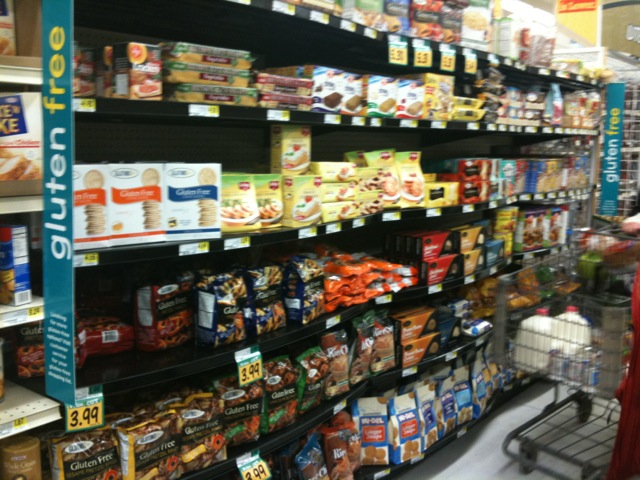
Gluten Free Section at Cub Foods, Blaine, MN

More evidence of the “mainstreaming trend” (according to the the news release) is  “the notable shift in the retail distribution of gluten-free products from specialty stores to chains. The surge in the sales and number of dedicated gluten-free products carried by the supermarkets and mass merchandisers demonstrates that gluten-free is becoming, as one marketer interviewed by Packaged Facts in the report states, ‘just a regular grocery item.’”  I’ll believe that when I see it.  I don’t think that’s nearly the case yet.  But it the shift is true– my local Cub Foods was a prime example when they expanded their gluten-free section and put it in the mainstream section earlier this month.

Do you think it’s on its way  to being as mainstream as other $6 billion dollar industries:  Halloween, potato chips or Yoga?  Feel free to comment below!  My take?  I think we’ll know it’s mainstream when all schools get behind it as a legitimate healthy diet that people should be able to choose and that it’s worth paying for.  Many schools are coming along, but it is very far from being mainstream.

Let’s keep watching over the next few years!

Wednesday, February 2, 2011

Gluten-free has gone mainstream – but how long will that last?

Gluten-free has gone mainstream – but how long will that last?

WENCY LEUNG | From Wednesday's Globe and Mail


In less than five years, sales of gluten-free products have nearly tripled, rising in tandem with the increasing number of new gluten-free goods. Beyond crackers, breads and pastas, it’s now possible to buy everything from gourmet gluten-free cookies at independent bakeries to gluten-free pizzas at restaurant chains such as Boston Pizza.

According to the Rockville, Md.-based research firm Packaged Facts, U.S. retail sales of gluten-free products reached $2.6-billion (U.S.) in 2010, up from $935-million in 2006. And in its 2011 Gluten Free Foods and Beverages report, the firm predicts sales will grow to $5.5-billion by 2015. A similar trend is under way in Canada, although precise national figures are not available. 

Full Article>

More Information>

Tuesday, February 1, 2011

The Future of Food Retailing in the U.S.

The Future of Food Retailing in the U.S.

The Future of Food Retailing in the U.S.

Growing competition, emerging retail formats, price wars, more private labels, SKU rationalization, and experiments with online marketing are trends reshaping the food retailing market.
Packaged Facts' latest market study, The Future of Food Retailing provides insightful macro and micro trend analyses for retailers and CPG marketers who seek merchandise, pricing, and marketing strategies for today's food retailing environment.
This market study answers the following questions:
  • How has the new economic climate changed consumer behavior?
  • Can smartphone apps, such as in-store navigation, drive more business?
  • Will recent mergers and acquisitions impact your bottom line?
  • How are personalized and digital coupons be leveraged to maximize profit?
  • Why is sustainability equal to profitability this year?
  • How are C-stores changing with the times?
  • How is Koger changing how consumer data is mined?
  • Why are food retailers morphing into foodservice and how does that translate to dollars?
Packaged Facts identifies the opportunities and strategies retailers and CPG marketers can use to protect and grow their businesses during 2011 and beyond.
More information:
Price/Info   |   Table of Contents   |   Place an Order

Monday, January 31, 2011

Catering Services on the Rebound, Consumers Seeking Healthier Options

January 27 2011 | Shannon Bryant | Ad-ology

Though the recession brought a period of famine to the catering foodservice industry, the feast is at hand as growth initiated in 2010 will continue through 2012 due to aggressive expansion into the catering space by limited–service establishments, the return of business event–driven spending, higher wedding spending, and a moderately healthier consumer, according to “Catering Trends in U.S. Foodservice,” by market research publisher Packaged Facts.


“Self–standing catering operations dominate sales, but full–service restaurants, limited–service restaurants and snack and beverage concepts also contribute significantly. Driven by aggressive catering launches and expansions, our experts view restaurant–based catering as a growth area into 2012,” says Don Montuori, publisher of Packaged Facts.

Catering revenue exceeded $14 billion in 2010 for an increase of 9% over a stormy 2009. Sales are expected to increase 9% and 7% in 2011 and 2012 respectively. Catering at foodservice and drinking places generated 75% of the catering market size, or $11 billion, in 2010, up 8%. Limited–service establishments are expected to lead catering sales growth through 2012 due to the segment’s ability to leverage moderate menu pricing structures, provide portable fare, and offer in-house operations capabilities.

The recession brought declines in both corporate and consumer spending on catered events. However, Packaged Facts predicts that as the economy continues to recover, businesses will be eager to build revenues again and such eagerness may indirectly fuel the catering business through increased sales meetings, business travel, and convention attendance. Recovery will also spur consumers to entertain with more catered affairs. Weddings, graduations, births, funerals, and other milestones will return as catalysts for consumer spending on catering.

Meanwhile, consumers seeking healthier options have caused a significant change in catering, offering an advantage to companies that highlight the health benefits of their products. Key among these is Subway, which has long promoted the low–fat sub sandwiches on its menu as part of its marketing plans. Other caterers are also seeing a preference for healthier choices, with consumers opting for Greek yogurt, granola, and toasted nuts instead of bagels and donuts, for instance.

More Information> https://www.packagedfacts.com/Catering-Trends-Foodservice-2848313/


[Source:  "Catering Trends in U.S. Foodservice," Packaged Facts.  11 Jan. 2011.  Web.  18 Jan. 2011.] Full Article: http://www.marketingforecast.com/archives/9777/trackback

Monday, October 25, 2010

students are 60% more likely than average to have dinner foodservice at a grocery store or supermarket

As part of our foodservice reports series, we’ve paid close attention to the increasing competition restaurants face from food retail prepared foods. According to Dinner Trends in U.S. Foodservice (October 2010), prepared foods are succeeding with students, who are limited-service restaurant stalwarts. Our proprietary consumer research indicates that students are 60% more likely than average to have dinner foodservice at a grocery store or supermarket, and about 40% more likely than average to have dinner at a convenience store/gas station.
So, while students may not go grocery shopping as often or spend as much there as consumers who have more established households, they clearly respond to convenience-minded offerings when they visit. We believe this provides significant opportunity for food retailers, not just because students are generally more convenience-driven but also because they are more health-conscious. As a group, students may be prone to say they want healthier fare and then make contrarian food decisions—a function of impulse, cost-considerations and the metabolic hubris of youth. But as more and more university foodservice programs have come to understand, students will embrace more healthful options if they meet cost and quality parameters—and the supermarket is optimally positioned to leverage own-branding to provide healthful fare.

But the most significant benefits may run longer-term. Having grown up during what we have coined “The Restaurant Age,” students aged 18-24 are as far removed from routine grocery shopping (and home cooking) as any generation before them. By providing prepared foods that meet their needs, food retailers not only drive a wedge between students and restaurants; they can also leverage that wedge to bring them into the home-cooking fold, by educating on meal planning and meal budgeting, or by using the prepared foods space as a bridge to introduce easy-to-cook meals that blend old-fashioned standards such as mac-and-cheese and spaghetti with new-found international and/or aspirational ingredients—for a reasonable cost, of course.More>

Monday, September 20, 2010

NEW! Artisan Foods: Culinary Trend Mapping Report

Artisan foods are everywhere, from their pervasive presence at large chain grocery store bakeries featuring in-house baked “artisan” loaves to fast casual chains such as Panera Bakery that have built an entire sandwich menu around freshly baked breads.

Manufacturers and restaurant operators have recognized that “artisan” has become another term for “quality.” It evokes small producers making traditional foods by hand, treating production as a craft and putting great care into the outcome. Larger producers are able to capture the aura of artisan with rustic-looking products, distinctive ingredients, unique cooking methods and stories that connect products to consumers.
 
This report explores the possibilities available in the world of artisan foods, and tracks some of the most exciting contemporary trends associated with this popular culinary segment.
Many artisans source their ingredients from nearby farms or grow their own, making a concerted effort to only use what’s available and in season to create a high quality, fresh-tasting product. Consumers savor these regional specialties and unique flavors. Artisan foods give consumers sustenance with a story featuring products that are more authentic and less conventional. For consumers it’s as much about nostalgia as it is about security in knowing they are feeding their families quality cuisine. Modern day artisans specialize and innovate on the traditional, producing savory and exotic ice creams, unusual types of cheese or specialized spirits to enliven and entice the palate. Like modern street food vendors, artisans make process part of their product, offering consumers a window into the traditions of the past. The current wave of artisan foodmakers is making the environment a priority, employing business strategies that minimize waste and negative impact on the earth. Reusable containers, compostable packaging and other eco-friendly practices allow consumers to be socially responsible while also enjoying an excellent product.
  • Local & Seasonal Eating —
  • Homemade/Authentic —
  • Flavor Adventure —
  • Consumer Engagement —
  • Going Green —
More Information>>

Saturday, September 18, 2010

New Market Research: Fresh Convenience Foods in the U.S.

During 2008 and 2009, as the “Great Recession” took hold, many consumer product marketers and retailers acted as if the walls were closing in on them, in many cases resorting to rampant price-slashing. But not fresh convenience food marketers and retailers, who instead saw an opening. Wisely gauging their main competition as coming from the restaurant industry instead of less costly unprepared food, they continued the innovations in quality and convenience that had been underway in the market for several years, and simultaneously began aggressively competing on price with the foodservice industry in an effort to woo customers away.

According to Packaged Facts, these efforts proved successful, spurring a shift by many consumers from restaurant meals to prepared food purchased at retail outlets. As a result, the market for fresh convenience foods grew by 5.1% in 2009 to reach sales of $22.3 billion. Packaged Facts expects these marketing and merchandising efforts to continue to prove successful over the short term, driving sales of fresh convenience foods up another 28% by 2014 to $28.5 billion.

More Information>>

Friday, September 17, 2010

Coffee and Ready-to-Drink Coffee in the U.S.: The Market and Opportunities in Retail and Foodservice, 6th Edition

McDonald's McCafe
As the U.S. economy slid deeper into recession during 2009, coffee marketers and foodservice operators moved in the opposite direction, digging out of the trench of 2008 with a variety of strategies designed to capitalize on the fact that even upscale coffee is a relatively thrifty luxury that offers comfort during stressful times. Two success stories were the rebound of Starbucks on the foodservice side and the revitalization of the former P&G retail coffee portfolio by J M. Smucker. Although the era when the coffee market grew effortlessly through premiumization may have ended, such upscale trends as the shifts towards specialty coffee beverages, gourmet beans and ethical consumerism are still clearly in force. What’s more, there’s ample opportunity for companies to capitalize on such trends as the economy recovers—not by ignoring the tougher times or reversing strategy, but by crafting an image that’s both upscale and responsive to consumers’ stronger-than-ever demand for value.

Packaged Facts’ Coffee and Ready-to-Drink Coffee in the U.S.: The Market and Opportunities in Retail and Foodservice, 6th Edition offers a comprehensive look at this $47.5 billion market, examining both the retail and foodservice sides of the business as well as the growing overlap of the two. On the retail...

More Information>>

Wednesday, September 15, 2010

O.C. frozen yogurt chain to open drive-through shop

September 13th, 2010, 8:28 am · posted by Nancy Luna, Staff Writer - The Orange County Register

There’s a new twist to the intense frozen yogurt competition in Southern California.
Buena Park-based Cherry on Top plans to open a drive through yogurt shop at the end of the month in Los Angeles near Culver City. The chain claims, and I’d have to agree, that this will be the “first drive-thru store of its kind and a first for any leading frozen yogurt company.”
“This will give guests the opportunity to come in the store for a self-serve experience, or go though the drive-thru for a quick fix,” company founder David Kim said.
Frozen dessert sales increased 2 percent to $25 billion in 2009, according to market research firm Packaged Facts.  A bulk of that growth was generated from the frozen yogurt sector, which has grown in popularity since Pinkberry debuted its tart swirly desserts to consumers in 2005.

I wonder how it will work to order toppings at the drive-thru?
 The 30-unit Cherry on Top, founded in 2007, has been one of the more successful brands to enter the market, which has been flooded with dozens of concepts over the last few years.  Many businesses have closed due to over-saturation amid  fierce competition.

Monday, September 13, 2010

Hispanic Food and Beverages

Hispanic Food and Beverages in the U.S.: Market and Consumer Trends in Latino Cuisine, 4th Edition : Packaged Facts
Burritos, enchiladas, quesadillas—you don’t have to go to Mexican restaurant or scour the ethnic foods aisle in your supermarket if that’s what you’re in the mood for. Hispanic foods and beverages have become so common a part of the American menu many consumers would have to think twice before characterizing them as a distinct ethnic cuisine. Are there any food courts in sports venues these days that don’t offer nachos as standard fare alongside hotdogs? Is there a supermarket or grocery anywhere in the country that doesn’t carry tortilla chips and salsa, even if there are no Hispanic consumers in their community?

With Hispanic foods and beverages achieving such prominence, it’s no wonder that sales were close to $7 billion in 2009, according to the recent report from Packaged Facts titled “Hispanic Food and Beverages in the U.S.: Market and Consumer Trends in Latino Cuisine, 4th Edition. This represented an increase of 28.7% from $5.4 billion in 2005. In addition, Packaged Facts predicts continued aggressive growth through 2014, with sales projected to top $9.5 billion in 2014.

The report details how the expanding appetite for Hispanic food and drink among non-Hispanic Americans combined with the rapid increase in the Hispanic population is driving sales of Mainstream Mexican products along with Authentic Hispanic and Nuevo Latino foods. Expanding distribution channels, the rise of the “foodie” and other key trends affecting the marketplace are described along with the changing demographics and other factors driving growth.  In addition, the report profiles major marketers, both in the manufacturing and foodservice arenas.

Friday, September 10, 2010

Premium foods pick up as marketers adjust to changing demand

Food Navigator, Lorraine Heller, 09-Sep-2010

Growth of gourmet and premium foods may have slowed from previous double-digits, but consumers are unwilling to give up some luxuries and marketers have found ways to respond to the changing demand, according to a new report.

Read Article>

Thursday, September 2, 2010

Value Pricing Breakfast Menus Helps Steady Daytime Restaurant Spending, Bodes Well for Future Growth

The most important meal of the day continues to face short-term challenges related to the recession, but market research publisher Packaged Facts' Breakfast Trends in the U.S. Foodservice Market predicts consumer spending on breakfast at restaurants will rebound from an anticipated downturn in 2010 to approach $38 billion in 2011, as current value menu pricing strategies influence future spending habits.

Fast food and QSR (quick-service restaurant) operators are playing the - price equals value - card for everything it's worth. By pushing the envelope with $1 deals, they risk enabling a pool of -extreme affordability- customers. But the upshot for breakfast is that it remains a relatively untapped daypart, so that traffic gained today may translate into additional revenue tomorrow, says Don Montuori, publisher of Packaged Facts. We believe that decisions by the likes of Denny's and Bob Evans to place everyday value for quality food at the forefront of their branding initiatives make a great deal of sense. Value pricing meets the reality of today's and tomorrow's lower-to-middle and middle-income consumers who frequent family restaurants. For breakfast, they are spinning full-service value menus and value in portion size.

Packaged Facts expects McDonald's foray into $1 breakfast menus to create pressure among other fast food/QSR players to match its lead an industry-wide trend previously glimpsed with the proliferation of non-breakfast $1 value menus. Burger King, Wendy's and Subway have already made major breakfast moves. The bottom line is that low cost resonates with restaurant breakfast users, with 31% of respondents to Packaged Facts' proprietary survey claiming they have been influenced by a maximum $3 price when selecting a restaurant for breakfast, versus 16% who placed a limit at $10.

Convenience influences consumer breakfast decisions, with convenience to work or errands, routine, and the need to get somewhere else quickly factoring in. Also relevant are breakfast menu features, such as getting a favorite menu item, wide variety, and healthy menu items. And, because more than half of U.S. adults drink coffee, restaurants have created value bundles that offer coffee with breakfast food to increase foot traffic.

Even though restaurant sales fell during the recession and initial recovery, breakfast has fared relatively well and has taken market share away from both the lunch and dinner dayparts. Packaged Facts found that only 34% of restaurant goers had eaten breakfast at a restaurant in the past month and an even smaller percentage of the general population said the same, which means the industry has an opportunity to woo the more than 150 million adult consumers who do not use restaurant breakfast.

Breakfast Trends in the U.S. Foodservice Market provides unique insights into consumers' evolving relationship with the breakfast daypart, helping restaurant operators position their brands and menus for consumers in 2010 and beyond. Highlights of the study include directional consumer behavioral and attitude analysis via Packaged Facts' proprietary Consumer Restaurant Outlook Tracker; proprietary analysis of average meal spend by restaurant type and by daypart, with a focus on the breakfast daypart, to help target consumers who can bring in higher guest check averages; restaurant and menu selection analysis, driven by Packaged Facts' proprietary consumer survey results; and much more.

More>>

Tuesday, August 31, 2010

Private Label Food and Beverages in the U.S.

At one time, private-label products accounted for a small share of the overall food and beverage market. But today, many retailers are claiming penetration rates of 25% or more of total sales.


Private Label Food & Beverage in The U.S. analyzes the U.S. market for foods and beverages sold under the proprietary labels of retailers, referred to in the trade as private-label or store-brand products.

The primary focus is on the mass-market products sold through supermarkets, big box, warehouse clubs, and mass merchandisers, but the report also examines trends affecting other food and beverage retailers, including convenience stores, drugstores, health and natural food stores. Included are estimates of total dollar sales, unit sales and average prices per unit for the 2005-2009 period along with forecasts for growth through 2014.


Competitor profiles include:
  • Aldi
  • Costco
  • Delhaize
  • Kroger
  • Safeway
  • Target
  • Trader Joe's
  • Wal-Mart
  • Whole Foods

More>>

Wednesday, August 25, 2010

Chocolate Market in the U.S.: Trends and Opportunities in Premium, Gourmet and Mass Chocolate Products : Packaged Facts

Chocolate Market in the U.S.: Trends and Opportunities in Premium, Gourmet and Mass Chocolate Products : Packaged Facts: "The U.S. chocolate market is a mature, differentiated and exacting market, which makes distinguishing yourself a challenge to marketers of chocolate products. Packaged Facts’ new report, The Chocolate Market in the U.S.: Trends and Opportunities in Premium, Gourmet and Mass Chocolate Products examines the current state of the industry and how the market will evolve over the next five years.
Chocolate marketers today are drawing inspiration from other segments of the food and beverage industry in an effort to boost sales - witness chocolates that feature super fruits, functional ingredients, savory touches and ethnic flavors. And chocolate product trends that worked in the past - single-source cocoa, high cocoa content, for example - may not be effective techniques for driving sales in the future.
Written by veteran chocolate market analyst Curtis Vreeland, The Chocolate Market in the U.S. looks at the myriad factors affecting chocolate retailing and consumption. For example, the report examines:

--What impact has the recession had on this $17.3 billion industry?
--How has product development changed to reflect evolving consumer taste buds and budgets?
--What constitutes “premium” and “gourmet” products in the chocolate market today?
--Have consumers changed their buying habits in the face of economic uncertainty?"


http://www.packagedfacts.com/Chocolate-2505082/

Tuesday, August 24, 2010

Chocolate Food Gifting - An American Staple

During the first half of 2010, holiday food gift sales increased from the previous year, indicating a promising year of growth in this sector. A rising interest in gourmet, natural/organic and specialty demographic food gifts (food gifts for kids, food gifts for sports fans, ethnic food gifts, etc.) is fueling demand.

Gift-boxed chocolates remain a mainstay of the food gifting market in the United States, with sales totaling $227.4 million in 2008 and $223.3 million in 2009, a 1.8% decrease.

The continuing expansion of the market for food-gifting is remarkable in that it comes at a time when Americans are reducing spending on gifts overall. Food gifting combines practicality (a consumable item and one that does not require an intimate knowledge of the recipient's lifestyle, needs or tastes). Although clothing remains the most popular Christmas holiday gift, it is also the most likely item to be returned.