|
Showing posts with label supermarket. Show all posts
Showing posts with label supermarket. Show all posts
Wednesday, March 23, 2011
As boomers turn 50 and enter their 60s, they are carrying with them a firm belief that getting older means getting better and they are making health and wellness a top priority.


Tuesday, March 15, 2011
The Cold Standard
March 2011 »
Frozen/Refrigerated »
Natural and Organic
By Jennifer Strailey
The frozen case offers a host of hot trends in natural and organic foods.
One of last year's hottest food and beverage trends came out of the supermarket freezer case, and, given the current economic outlook and consumer shopping habits, industry analysts believe this cold front has moved in for the long stretch.
U.S. retail sales of frozen foods and beverages through all retail channels totaled $55.9 billion in 2010, up 1.7 percent from the previous year, according to Packaged Facts, a division of MarketResearch.com, in its recently released report, "Frozen Foods in the U.S., 3rd Edition" (January 2011). The consumer market research firm, based in Rockville, Md., expects that number to reach $70 billion in 2015.
There's no question that frozen food sales have been driven in part by the economy, which has seen a decline in Americans dining out in favor of eating at home. Frozen foods provide a more affordable alternative to eating out, while at the same time satisfying consumers' eternal craving for convenience. But more recently, manufacturers have introduced a slew of natural, organic and wellness-oriented frozen food and beverage products that has brought attention — and health cred — to the category like never before.
Wednesday, March 9, 2011
5 Hygiene Products Every Man Should Have

Competition on Aisle Five
Competition on Aisle Five
 A new study finds consumers are flocking to grocery-store prepared meals for two reasons. And restaurants should be worried.
Quick-service restaurants feeling more intense competition for the consumer’s dollar might not only look at their dining rivals across the street, but their supermarket down the block.
Friday, February 4, 2011
Gluten Free Gone Mainstream?
Source: http://thesavvyceliac.com/2011/02/02/gluten-free-gone-mainstream/
Going “mainstream” for gluten free foods may have a different meaning for everyone. For restaurants, it may just mean putting together a gluten free menu (regardless of education), for grocery stores it may mean putting it in the main aisles (and the employees know what you’re talking about if you ask them a question), but for me it’s all of the above and more — including a good basic public awareness on what it really means.
That could be the case if new product survey which looks ahead a few years is accurate. According to a news release for “Gluten-Free Foods and Beverages in the U.S., 3rd Edition” by market research publisher Packaged Facts, the gluten-free market is currently a $2.6 billion dollar industry. It reports it will likely double to about $6 billion by 2015! $6 billion is similar to the current industries of Yoga, Halloween, and Potato Chips! What’s more mainstream than Halloween and potato chips (well maybe not together). But even if you look at Yoga, I think one might consider that when it started as a fitness regime in the US, it wasn’t considered mainstream and look where it is today!
People are buying gluten-free to treat celiac, autism or some other ailment but also as a healthy kick to their diet. I do think the healthy gluten-free “fad” has benefited those in the celiac world– not so much with education regarding a correct gluten-free diet, but rather in selection for foods for us.
More evidence of the “mainstreaming trend” (according to the the news
release) is “the notable shift in the retail distribution of
gluten-free products from specialty stores to chains. The surge in the
sales and number of dedicated gluten-free products carried by the
supermarkets and mass merchandisers demonstrates that gluten-free is
becoming, as one marketer interviewed by Packaged Facts in the report
states, ‘just a regular grocery item.’” I’ll believe that when I see
it. I don’t think that’s nearly the case yet. But it the shift is
true– my local Cub Foods was a prime example when they expanded their
gluten-free section and put it in the mainstream section earlier this
month.
Do you think it’s on its way to being as mainstream as other $6 billion dollar industries: Halloween, potato chips or Yoga? Feel free to comment below! My take? I think we’ll know it’s mainstream when all schools get behind it as a legitimate healthy diet that people should be able to choose and that it’s worth paying for. Many schools are coming along, but it is very far from being mainstream.
Let’s keep watching over the next few years!
Going “mainstream” for gluten free foods may have a different meaning for everyone. For restaurants, it may just mean putting together a gluten free menu (regardless of education), for grocery stores it may mean putting it in the main aisles (and the employees know what you’re talking about if you ask them a question), but for me it’s all of the above and more — including a good basic public awareness on what it really means.
That could be the case if new product survey which looks ahead a few years is accurate. According to a news release for “Gluten-Free Foods and Beverages in the U.S., 3rd Edition” by market research publisher Packaged Facts, the gluten-free market is currently a $2.6 billion dollar industry. It reports it will likely double to about $6 billion by 2015! $6 billion is similar to the current industries of Yoga, Halloween, and Potato Chips! What’s more mainstream than Halloween and potato chips (well maybe not together). But even if you look at Yoga, I think one might consider that when it started as a fitness regime in the US, it wasn’t considered mainstream and look where it is today!
Could gluten-free food be the next Yoga?Well, that answer remains to be seen– but the survey showed, “The #1 motivation for buying gluten-free food products is that they are deemed healthier than their conventional counterparts.” Don Montuori, publisher of Packaged Facts is quoted in the release, “…there is evidence suggested that eliminating gluten from the diet may relieve autism in children and adult rheumatoid arthritis. Add to that the healthy ‘aura’ some consumers have attached to gluten-free products, and you create a demand for these foods and beverages that mainstream food manufacturers and retailers are increasingly happy to satisfy.”
People are buying gluten-free to treat celiac, autism or some other ailment but also as a healthy kick to their diet. I do think the healthy gluten-free “fad” has benefited those in the celiac world– not so much with education regarding a correct gluten-free diet, but rather in selection for foods for us.
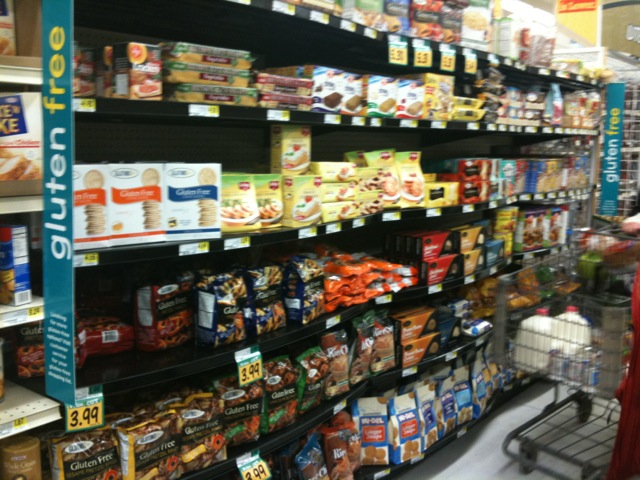 |
| Gluten Free Section at Cub Foods, Blaine, MN |
Do you think it’s on its way to being as mainstream as other $6 billion dollar industries: Halloween, potato chips or Yoga? Feel free to comment below! My take? I think we’ll know it’s mainstream when all schools get behind it as a legitimate healthy diet that people should be able to choose and that it’s worth paying for. Many schools are coming along, but it is very far from being mainstream.
Let’s keep watching over the next few years!
Thursday, February 3, 2011
High Quality Prepared Food Departments Add Dine-in Cafes to Drive Traffic at Grocery Stores
 |
| Prepared food bar at Wegmans. Photo Courtesy of toujourspretamanger.com |
Been to a Wegmans lately?
The Market Cafés have pizza, freshly-made sushi, burritos, Thai food,
and vegetarian choices for dining in or taking home. And Kroger took out the underused
salad bars to make way for prepackaged salads, sandwiches, and carnitas. My own
local Harris Teeter offers chef-staffed prepared food stations. Imagine that, a live person ready to make my
perfect California roll.
As a self-proclaimed 'foodie' you would think I'd stick to
the trendy new restaurants in downtown D.C. But on today’s shoestring budget that’s
not possible. Instead, I find myself eating
what I want at attractive, upscale bistro area of my local grocery store.
The traditional grocery channel made 57% of retail food &
beverage dollar sales in 2010, according to market research publisher Packaged
Facts. Through their in-store foodservice options, traditional grocery stores
stand to further grow in share of U.S. food & beverage sales.

Grocery stores are aiming to make shopping more appealing by
providing upscale restaurant-like experiences to customers. In order to attract
as many shoppers as possible, stores are providing a wide range of restaurant-style
foods and amenities: wood-fired pizzas, made-to-order soups, sandwich and sushi
bars, and dining areas. And the eager (read: hungry) shoppers who want to grab
a quick meal while grabbing the groceries, take a break for lunch, or get a
snack before the drive or walk back home are eating it up.
Packaged Facts analysis expects to see food retailing and
foodservice channels continue to converge around fresh prepared foods, working
fervently to make consumption more convenient. As a result, the competitive
lines between grocery stores, restaurants, convenience stores, and other
channels will continue to blur in a U.S. food & beverage retail market projected
by Packaged Facts to reach nearly $700 billion by 2015.
At the end of the day,
when the sushi stand has been cleaned and the fresh olive bar has closed, what else
will retailers be looking to add? Besides adding to their variety of on-the-go
foods, deli and prepared food departments will expand with easily accessible
take-out entrances and check-out lanes; curbside pick-up and call-ahead
ordering; website and smart phone apps for ordering.
Well, that’s where its heading, but for me its lunch-time
and I’m heading over to the Parisian café at my local Whole Foods Market. Or
maybe a grilled vegetable sub at Teeters? I could really go for some sushi-…
Wednesday, February 2, 2011
Gluten-free has gone mainstream – but how long will that last?

Gluten-free has gone mainstream – but how long will that last?
WENCY LEUNG | From Wednesday's Globe and Mail
Published
In less than five years, sales of gluten-free products have nearly tripled, rising in tandem with the increasing number of new gluten-free goods. Beyond crackers, breads and pastas, it’s now possible to buy everything from gourmet gluten-free cookies at independent bakeries to gluten-free pizzas at restaurant chains such as Boston Pizza.
According to the Rockville, Md.-based research firm Packaged Facts, U.S. retail sales of gluten-free products reached $2.6-billion (U.S.) in 2010, up from $935-million in 2006. And in its 2011 Gluten Free Foods and Beverages report, the firm predicts sales will grow to $5.5-billion by 2015. A similar trend is under way in Canada, although precise national figures are not available.
Full Article>
More Information>
Wednesday, November 10, 2010
Frozen food manuf. find themselves in spot during the recession
Marketers of frozen convenience food have found themselves caught between a rock and a hard place during the economic downturn. Though fresh convenience food has gained through positioning that casts it as a less expensive alternative to restaurant food during a time of recession, frozen convenience food is frequently viewed as a more expensive, less fresh alternative to cooking from scratch at home. The frozen food categories that have been able to grow substantially in this environment are therefore the ones that have been able to elude this paradigm.

Specifically, the mammoth frozen pizza category and the spunky hand-held breakfast category have both found a way to go head-to-head with restaurants; and the prepared vegetable category has been able to triumph on the freshness front via the development of steaming techniques. According to Packaged Facts, these three categories have led the way sales-wise, enabling an otherwise ambivalent market for frozen convenience foods to grow by a modest 2.0% in 2010 to reach sales of $16.8 billion. Packaged Facts expects that marketers in other categories will soon adopt similar strategies, driving sales of fresh convenience foods up another 10% by 2015, to $18.6 billion.
Monday, October 25, 2010
students are 60% more likely than average to have dinner foodservice at a grocery store or supermarket
As part of our foodservice reports series, we’ve paid close attention to the increasing competition restaurants face from food retail prepared foods. According to Dinner Trends in U.S. Foodservice (October 2010), prepared foods are succeeding with students, who are limited-service restaurant stalwarts. Our proprietary consumer research indicates that students are 60% more likely than average to have dinner foodservice at a grocery store or supermarket, and about 40% more likely than average to have dinner at a convenience store/gas station.

So, while students may not go grocery shopping as often or spend as much there as consumers who have more established households, they clearly respond to convenience-minded offerings when they visit. We believe this provides significant opportunity for food retailers, not just because students are generally more convenience-driven but also because they are more health-conscious. As a group, students may be prone to say they want healthier fare and then make contrarian food decisions—a function of impulse, cost-considerations and the metabolic hubris of youth. But as more and more university foodservice programs have come to understand, students will embrace more healthful options if they meet cost and quality parameters—and the supermarket is optimally positioned to leverage own-branding to provide healthful fare.
But the most significant benefits may run longer-term. Having grown up during what we have coined “The Restaurant Age,” students aged 18-24 are as far removed from routine grocery shopping (and home cooking) as any generation before them. By providing prepared foods that meet their needs, food retailers not only drive a wedge between students and restaurants; they can also leverage that wedge to bring them into the home-cooking fold, by educating on meal planning and meal budgeting, or by using the prepared foods space as a bridge to introduce easy-to-cook meals that blend old-fashioned standards such as mac-and-cheese and spaghetti with new-found international and/or aspirational ingredients—for a reasonable cost, of course.More>
Friday, September 24, 2010
Sunday, September 19, 2010
Prepared Foods and Ready-to-Eat Foods at Retail: The New Competition to Foodservice
 |
| Wegmans Cafe |
According to Packaged Facts’ proprietary consumer research, 64% of adult consumers have gotten ready-to-eat/heat-and-eat food from a grocery store or supermarket in the last month. Moreover, in terms of total usage occasions, grocery-related prepared foods use leads both family and casual restaurant segments and trails only fast food/QSR.
While convenience stores have also relied heavily on prepared foods and foodservice sales for sales and higher margins, increasing competition extends to supercenters, warehouse clubs, convenience stores and drug stores. At a time when food value is so closely associated with low cost and convenience—and when consumers increasingly perceive private label food retail brands as competitive with name brands on cost and quality—prepared and ready-to-eat foods programs that deliver on quality, taste and convenience can not only compete with foodservice fare, but can also help food retailers adapt to modern consumer lifestyles.
More Information>>
Friday, September 17, 2010
Gluten-free has gone big time, but why so popular?
09/16/2010 - Michael Hill - Associated Press
 |
This July 5, 2005 file photo shows gluten-free products on
display at a Hannaford Supermarket in Albany, N.Y. U.S.
sales of gluten-free food has more than doubled
since 2005 to over $1.5 billion, according to the market research
company Packaged Facts. And the growth spurt
is expected to continue at least through 2012.
(AP Photo/Jim McKnight, FILE)
|
Gwyneth Paltrow gushes over gluten-free. Chelsea Clinton's wedding cake was baked without it. The new Old Spice guy avoids the ubiquitous protein to help stay buff. In fact, odds are good you too have tried — or at least encountered — a product with the gluten removed.
Because gluten-free is what low-carb was a decade ago: The "it" diet discussed on daytime talk shows, promoted by hyper-slim actresses and adopted by masses. Grocery aisles are stocked with the likes of gluten-free pasta, crackers, cereal and beer.
Americans are enthusiastically exiling a dietary staple that wasn't even in most people's vocabulary a decade ago.
But why?
Unlike some other dietary boogeymen like trans-fats, gluten is not inherently bad to eat. Only a small percentage of people can't tolerate the protein, which occurs naturally in wheat, barley and rye. Plus, banning gluten from your diet can be really hard.
Not only is gluten an essential element of traditional breads and pastas (it's the protein that gives them their structure), it often is used as a thickening agent in processed foods, such as ketchup and ice cream. And cutting out gluten is no guarantee of weight loss.
Tuesday, September 14, 2010
New sandwiches meet consumer interests, values
Sandwiches aren't just an important part of the American diet; they are essential to it. And lucky for hungry consumers, sandwiches are undergoing exciting flavor and quality upgrades on every level -- carriers, fillings and condiments.
New sandwich trends are driven by artisan and sustainable ingredients, American regional and global flavor profiles, and even better nutrition, according to the "Sandwiches: Culinary Trend Mapping Report" from the Center for Culinary Development (CCD) and market research publisher Packaged Facts.
Read Full Article>
New sandwich trends are driven by artisan and sustainable ingredients, American regional and global flavor profiles, and even better nutrition, according to the "Sandwiches: Culinary Trend Mapping Report" from the Center for Culinary Development (CCD) and market research publisher Packaged Facts.
Read Full Article>
Competition on Aisle Five

By Daniel P. Smith - QSR Magazine
Quick-service restaurants feeling more intense competition for the consumer’s dollar might not only look at their dining rivals across the street, but their supermarket down the block.
A growing array of prepared and ready-to-eat foods at retail outlets such as Walmart and Kroger are attracting consumers and threatening to put a dent in quick-service business, says a new report from Packaged Facts titled “Prepared Foods and Ready-to-Eat Foods at Retail: The New Competition to Foodservice.”
The report surveyed 1,881 U.S. adult consumers and found that half of respondents were more likely to eat dinner at home than they were three months ago, while 64 percent reported purchasing ready-to-eat or heat-and-eat food from a grocery store within the last month. The study predicts that supermarket prepared foods will grow to $14 billion by 2011, largely motivated by consumers migrating away from restaurants during the recession in search of value and one-stop-shop convenience.
“We see a lot of momentum here and expect growth of 7 percent from 2010 to 2011, which is a pretty monumental surge in a supermarket industry that has been accustomed to losing share,” says David Morris, the report’s chief analyst.
The study cites two distinct groups gobbling up supermarket-prepared foods: those who seek low-cost, quick alternatives out of necessity or convenience and those who see the prepared foods as an alternative to home cooking. Both groups have long been primary clientele for the quick-service category, heightening restaurant concerns in an already challenging environment.
“This is not a new trend, but we do see this as the year that grocery stores put this strategy at the forefront, which should be a competitive concern for restaurants,” Morris says.
Suzanne Long, a grocery retail analyst with New York–based SSA & Company, says grocery stores began stocking prepared meals more aggressively in 2005–2006. Noting a consumer conscious of price and time, the industry saw an opportunity to modernize its decades-old business model and push into new areas. Offering prepared meals was supposed to generate additional in-store purchases.
“There’s been a huge trend toward this for years now, but the retailers are looking far more at sales and market share over profit,” Long says.
Although still in its formative years, the prepared-meals trend is gaining momentum, particularly as the recession lags. Grocery chains continue to experiment with more diverse offerings, portion size, and operational efficiencies to better compete with restaurants and draw customers.
“Grocery stores feel as if they haven’t come close to achieving their goal of grabbing greater market share, so there’s absolutely a continued push,” Long says.
The study predicts that supermarket prepared foods will grow to $14 billion by 2011.While the threat of increased competition in an already heated foodservice field brings concern to some restaurant brands, others see the rise of grocery stores in the prepared-foods arena as a complement—not a competitor—to business.
In June, Canadian chain Tim Hortons announced it would add 48 self-service coffee kiosks to new Tops Friendly Markets locations in the northeast U.S. The partnership adds to Tim Hortons’ already strong relationship with the grocer, which includes existing kiosks in 82 Tops outlets in upstate New York. Each of the locations serves Tim Hortons’ signature blend coffee, Timbits donut holes, hot chocolate, and tea.
“We’re taking the brand to the people,” says Tim Hortons COO David Clanachan. “The key thing is convenience. People are time-starved and they want what they want. If we make our products available and win loyal customers, then it feeds our brand.”
Whether competitor or complement, there remains little question that grocery’s major players intend to challenge restaurants. While grocery stores might succeed and expand in the short term, Morris sees a ceiling to their market share.
“The grocery stores cannot be ignored, but they still cannot recreate the restaurant experience unless they build out and create their own branded restaurant-like setting,” he says. “That’s one thing the restaurant world has going for it, even as the competition grows.”
For information on Prepared Foods and Ready-to-Eat Foods at Retail: The New Competition to Foodservice click here.
Friday, September 10, 2010
Food service lunch spending forecast to rise
FoodBusinessNews.net, September 8, 2010
by Keith Nunes
____________________
Consumer spending on lunch served in restaurants is forecast to rebound 2% in 2011 and reach $114 billion following two years of recession-related declines, according to “Lunch Trends in the U.S. Foodservice Market,” a report produced by research publisher Packaged Facts. After rising to $119 billion in 2008, lunch daypart sales declined 4% in 2009, and sales are projected to fall another 3% in 2010 to $112 billion.
“This has been a very tough climate for lunch food service and its counterparts, and that won’t change overnight although change is coming," said Don Montuori, publisher of Packaged Facts. “Growth in the lunch daypart still faces a few near-term challenges, including the impact of unemployment on work-driven restaurant routines, bargain-minded consumers who weigh the cost of a bagged lunch against the indulgence of eating out, and an industry environment in which players are chasing foot traffic at the expense of guest check through the extreme push of value meal deals.”
A survey of consumers conducted by Packaged Facts showed that interest in lunchtime meals priced under $5 and under $10 is stable across household income brackets, suggesting price sensitivity among a large segment of diners regardless of their personal wages. Respondents aged 18 to 24 are 60% more likely than average to choose a restaurant because it offers meals for under $3.
Limited time offers and menu options that allow consumers to bundle their meal components for a set price are two menu strategies that have proven attractive to consumers, according to Packaged Facts. Examples cited in the report include Taco Bell’s $2 Meal Deal and Jack in the Box’s Pick 3 for $3 customizable limited time offer value meal.
______________________
Read Food Business News Article
by Keith Nunes
____________________
Consumer spending on lunch served in restaurants is forecast to rebound 2% in 2011 and reach $114 billion following two years of recession-related declines, according to “Lunch Trends in the U.S. Foodservice Market,” a report produced by research publisher Packaged Facts. After rising to $119 billion in 2008, lunch daypart sales declined 4% in 2009, and sales are projected to fall another 3% in 2010 to $112 billion.
“This has been a very tough climate for lunch food service and its counterparts, and that won’t change overnight although change is coming," said Don Montuori, publisher of Packaged Facts. “Growth in the lunch daypart still faces a few near-term challenges, including the impact of unemployment on work-driven restaurant routines, bargain-minded consumers who weigh the cost of a bagged lunch against the indulgence of eating out, and an industry environment in which players are chasing foot traffic at the expense of guest check through the extreme push of value meal deals.”
A survey of consumers conducted by Packaged Facts showed that interest in lunchtime meals priced under $5 and under $10 is stable across household income brackets, suggesting price sensitivity among a large segment of diners regardless of their personal wages. Respondents aged 18 to 24 are 60% more likely than average to choose a restaurant because it offers meals for under $3.
Limited time offers and menu options that allow consumers to bundle their meal components for a set price are two menu strategies that have proven attractive to consumers, according to Packaged Facts. Examples cited in the report include Taco Bell’s $2 Meal Deal and Jack in the Box’s Pick 3 for $3 customizable limited time offer value meal.
______________________
Read Food Business News Article
Premium foods pick up as marketers adjust to changing demand
Food Navigator, Lorraine Heller, 09-Sep-2010
Growth of gourmet and premium foods may have slowed from previous double-digits, but consumers are unwilling to give up some luxuries and marketers have found ways to respond to the changing demand, according to a new report.
Read Article>
Growth of gourmet and premium foods may have slowed from previous double-digits, but consumers are unwilling to give up some luxuries and marketers have found ways to respond to the changing demand, according to a new report.
Read Article>
Novel fibers to grow 750% as consumers seek fiber-rich foods
By Stephen Daniells, 10-Sep-2010, Nutra Ingredients
 The use of novel fibers in food products is set to sky-rocket over the next few years, with growth of 750 percent predicted, according to a new report from Packaged Facts.
Consumer interest in dietary fiber has been growing with scientific studies linking increased intake to reduced risks of cancers such as colorectal and cardiovascular disease, digestive health benefits and weight management.
A 2008 International Food Information Council survey found 77 percent of people are proactively trying to consume additional fiber.
Despite such good intentions, however, many Americans only achieve about 50 percent of their recommended amount of 25 to 30 grams of fiber daily.
And such stats are driving the introduction of new fiber-fortified food and beverage products, according to a new report Fiber Food Ingredients in the U.S.: Soluble-, Insoluble- and Digestive-Resistant Types by market research publisher Packaged Facts.
While interest in all types of fibers – insoluble and soluble – is expected to increase, the biggest growth is expected for so-called novel fibers. Packaged Facts defined novel fiber as “one that has not historically been viewed as a fiber food ingredient. This includes, but is not limited to inulin, FOS, GOS, resistant maltodextrin and soluble corn fiber.”
“Packaged Facts determined that sales of all fiber food ingredients (i.e., conventional, insoluble-type fibers; conventional, soluble-type fibers; and novel fiber food ingredients) will continue to increase indefinitely, as the market for fiber-enhanced foods is still in its infancy,” said Don Montuori, publisher of Packaged Facts.
“There is a great deal of room for growth across almost all food categories, which presents an opportunity for the many different fiber ingredients that are among the most popular with today’s food formulators,” added Montouri.
Novel growth
The market researcher is predicting a significant growth for these novel fibers, with the category predicted to increase its share of the market by more than 750 percent, jumping 35 percentage points from an almost 5 percent share in 2004 to a 39 percent share in 2014.
Packaged Facts estimates that in 2004, 91 percent of all fiber food ingredient sales were of conventional, insoluble-type fibers, which contains cellulose, hemicellulose and lignin and cannot be dissolved in water.
The remaining 9 percent share was split evenly between conventional, soluble-type fibers and emerging, novel fibers. The market researcher projects that insoluble fibers will decrease to 53.3 percent by 2014, while the share for the mostly new or newly refined conventional, soluble-type fibers will decrease slightly to 7.4 percent.
Soluble versus insoluble
Studies have also reported that insoluble fiber may reduce the risk of obesity and diabetes, but the biological mechanism underlying the benefits has only been assumed.
The assumption was that the fiber reduced the glycemic response (a rise in blood glucose), thereby increasing satiety and decreasing energy intake. A lower glycemic response decreases the demand for insulin, therefore reducing the risk of type 2 diabetes.
In Europe and Japan, soluble fiber has the greater market share than insoluble. In the US, where the entire fiber market was worth $192.8m (€151.0m) in 2004, insoluble fiber dominates the market with $176.2m (€138.0m), and $16.6m (€13.0m) soluble.
But while Frost and Sullivan predicts overall growth in the US to $470m (€369m) by 2011, the soluble fiber sector is expected to increase by almost twice the compound annual growth rate (CAGR) compared to insoluble fiber - 26.3 percent compared to 13.1 percent.
The arrival of multinationals
Data from Datamonitor in 2009 indicated that food manufacturers are increasingly adding fiber to their products, in a move described as going “back to basics”.
The market researcher said fiber has become an ingredient of choice for products targeting health conscious consumers and products designed to help combat obesity.
Based on data from its Product Launch Analytics, which tracks new products entering the global marketplace, Datamonitor said the percentage of new food products launched in the US that claim to be high in fiber hit 6.3 percent in 2008, up from 5.2 percent in 2006.
“Consumers have long known that fiber is ‘good for you.’ Now food makers are redoubling their efforts to increase the fiber content of many popular food products,” said Datamonitor.
Companies that have launched products touting their fiber content include the multinationals PepsiCo, Kraft, Campbell Soup, Kellogg and Dannon.
More>

Consumer interest in dietary fiber has been growing with scientific studies linking increased intake to reduced risks of cancers such as colorectal and cardiovascular disease, digestive health benefits and weight management.
A 2008 International Food Information Council survey found 77 percent of people are proactively trying to consume additional fiber.
Despite such good intentions, however, many Americans only achieve about 50 percent of their recommended amount of 25 to 30 grams of fiber daily.
And such stats are driving the introduction of new fiber-fortified food and beverage products, according to a new report Fiber Food Ingredients in the U.S.: Soluble-, Insoluble- and Digestive-Resistant Types by market research publisher Packaged Facts.
While interest in all types of fibers – insoluble and soluble – is expected to increase, the biggest growth is expected for so-called novel fibers. Packaged Facts defined novel fiber as “one that has not historically been viewed as a fiber food ingredient. This includes, but is not limited to inulin, FOS, GOS, resistant maltodextrin and soluble corn fiber.”
“Packaged Facts determined that sales of all fiber food ingredients (i.e., conventional, insoluble-type fibers; conventional, soluble-type fibers; and novel fiber food ingredients) will continue to increase indefinitely, as the market for fiber-enhanced foods is still in its infancy,” said Don Montuori, publisher of Packaged Facts.
“There is a great deal of room for growth across almost all food categories, which presents an opportunity for the many different fiber ingredients that are among the most popular with today’s food formulators,” added Montouri.
Novel growth
The market researcher is predicting a significant growth for these novel fibers, with the category predicted to increase its share of the market by more than 750 percent, jumping 35 percentage points from an almost 5 percent share in 2004 to a 39 percent share in 2014.
Packaged Facts estimates that in 2004, 91 percent of all fiber food ingredient sales were of conventional, insoluble-type fibers, which contains cellulose, hemicellulose and lignin and cannot be dissolved in water.
The remaining 9 percent share was split evenly between conventional, soluble-type fibers and emerging, novel fibers. The market researcher projects that insoluble fibers will decrease to 53.3 percent by 2014, while the share for the mostly new or newly refined conventional, soluble-type fibers will decrease slightly to 7.4 percent.
Soluble versus insoluble
Studies have also reported that insoluble fiber may reduce the risk of obesity and diabetes, but the biological mechanism underlying the benefits has only been assumed.
The assumption was that the fiber reduced the glycemic response (a rise in blood glucose), thereby increasing satiety and decreasing energy intake. A lower glycemic response decreases the demand for insulin, therefore reducing the risk of type 2 diabetes.
In Europe and Japan, soluble fiber has the greater market share than insoluble. In the US, where the entire fiber market was worth $192.8m (€151.0m) in 2004, insoluble fiber dominates the market with $176.2m (€138.0m), and $16.6m (€13.0m) soluble.
But while Frost and Sullivan predicts overall growth in the US to $470m (€369m) by 2011, the soluble fiber sector is expected to increase by almost twice the compound annual growth rate (CAGR) compared to insoluble fiber - 26.3 percent compared to 13.1 percent.
The arrival of multinationals
Data from Datamonitor in 2009 indicated that food manufacturers are increasingly adding fiber to their products, in a move described as going “back to basics”.
The market researcher said fiber has become an ingredient of choice for products targeting health conscious consumers and products designed to help combat obesity.
Based on data from its Product Launch Analytics, which tracks new products entering the global marketplace, Datamonitor said the percentage of new food products launched in the US that claim to be high in fiber hit 6.3 percent in 2008, up from 5.2 percent in 2006.
“Consumers have long known that fiber is ‘good for you.’ Now food makers are redoubling their efforts to increase the fiber content of many popular food products,” said Datamonitor.
Companies that have launched products touting their fiber content include the multinationals PepsiCo, Kraft, Campbell Soup, Kellogg and Dannon.
More>
Wednesday, September 8, 2010
Lunch Trends in the U.S. Foodservice Market
To help foodservice industry participants face challenges unique to the lunch daypart, Lunch Trends in the U.S. Foodservice Market provides insight on the lunch goer’s decision-making process. By putting a finger to the lunch goer’s pulse, we provide insight on two keys factors to lunch-time foodservice: how and why the consumer decided on a specific restaurant from which to obtain lunch, and how and why that consumer decides what to order from the menu.
 Introductory findings include the following: When deciding on a restaurant from which to obtain lunch, 37% of lunch goers cite a favorite menu item as influencing their choice, and some 36% cite a different menu item than what they have at home. But low cost has become the industry mantra—and is also important to many consumers. About 35% cite a meal priced under $5 as an influence when selecting a restaurant, and 31% say that a meal priced under $10 has influenced them to select a restaurant for lunch.
With proprietary consumer research laying the foundation, this report weaves consultative insight with analysis of lunchtime limited-time offer and value trends; current lunchtime guest check averages; planned restaurant spending; and guest traffic patterns at selected brands. We also shine a light on leading lunch-centric brands, by outlining menu strategies and related innovations, and then tying them to demographic analysis of the brand users’ diet, health, and food attitudes; and usage patterns. The report also trends lunch daypart sales by demographics such as income, age, region, and race/ethnicity. Analysis also focuses on consumers particularly important to the lunch daypart, such as the full-time and part-time employed.
While the restaurant industry is the primary focus of the report, consumer survey assessment incorporates prepared foods at grocery stores and convenience stores, and trend analysis incorporates both restaurants and food retail.
More>

With proprietary consumer research laying the foundation, this report weaves consultative insight with analysis of lunchtime limited-time offer and value trends; current lunchtime guest check averages; planned restaurant spending; and guest traffic patterns at selected brands. We also shine a light on leading lunch-centric brands, by outlining menu strategies and related innovations, and then tying them to demographic analysis of the brand users’ diet, health, and food attitudes; and usage patterns. The report also trends lunch daypart sales by demographics such as income, age, region, and race/ethnicity. Analysis also focuses on consumers particularly important to the lunch daypart, such as the full-time and part-time employed.
While the restaurant industry is the primary focus of the report, consumer survey assessment incorporates prepared foods at grocery stores and convenience stores, and trend analysis incorporates both restaurants and food retail.
More>
Tuesday, August 31, 2010
Private Label Food and Beverages in the U.S.
At one time, private-label products accounted for a small share of the overall food and beverage market. But today, many retailers are claiming penetration rates of 25% or more of total sales.
Private Label Food & Beverage in The U.S. analyzes the U.S. market for foods and beverages sold under the proprietary labels of retailers, referred to in the trade as private-label or store-brand products.
Competitor profiles include:
More>>
The primary focus is on the mass-market products sold through supermarkets, big box, warehouse clubs, and mass merchandisers, but the report also examines trends affecting other food and beverage retailers, including convenience stores, drugstores, health and natural food stores. Included are estimates of total dollar sales, unit sales and average prices per unit for the 2005-2009 period along with forecasts for growth through 2014.
Competitor profiles include:
- Aldi
- Costco
- Delhaize
- Kroger
- Safeway
- Target
- Trader Joe's
- Wal-Mart
- Whole Foods
More>>
Subscribe to:
Posts (Atom)