|
Tuesday, March 29, 2011
What will be the next “big bang” in the U.S. pet market, and what can marketers and retailers do now to help expedite this all-important future sales driver?


Thursday, March 24, 2011
Trends in OTC and veterinary-dispensed pet supplements usage vs. usage of special-purpose nutritional formula pet foods and treats
|

Tuesday, March 15, 2011
QSR Magazine: What Happened to Table Service?
What Happened to Table Service?

The meal deals that spelled survival for sit-down restaurants were like Black Friday to consumers, says David Morris, author of the report Dinner Trends in the U.S. Foodservice Market for Packaged Facts. The upshot was giddy guests (higher guest traffic) with lower guest checks. Great for the consumer, but depressing for operators who are now trying to unwind themselves from the spiral.
[CONT.]
Wednesday, March 9, 2011
Competition on Aisle Five
 A new study finds consumers are flocking to grocery-store prepared meals for two reasons. And restaurants should be worried.
 Friday, February 25, 2011
More Food Service Operators to Use Social Media

The new Social Media and Technology in the U.S. Foodservice Industry: Trends and Opportunities for an Emerging Market report by Packaged Facts explains that everything has changed in the food service industry. Don Monturori, publisher of Packaged Facts says, “We believe the restaurant industry is in the midst of being shaped by the convergence of the mobile, yet always connected, consumer; location-based and context-aware technological innovation, and mobile payments, which already demonstrate the potential to redefine how to cultivate restaurant guest loyalty, incentivize dining occasions, and better tailor marketing messages.” As proof of this new trend, consider these facts:
- Almost 1/3rd (31%) of consumers who frequent restaurants for eat-in or take-out meals use their computers to place orders.
- About 1/5th (21%) of consumers use mobile phones or other devices to place restaurant orders.
As the restaurant industry battles to regain the losses suffered during the recession, most operators will be turning to lower-cost forms of promotions. For many, social media seems to fit the bill.
[Source: Facebook, Twitter and Smartphones Lead Social Media-Fueled Innovation within U.S. Foodservice. PackagedFacts.com. 8 Feb. 2011. Web. 24 Feb. 2011]
More Food Service Operators to Use Social Media - marketingforecast.com
Tuesday, February 15, 2011
Social Media and Technology in the U.S. Foodservice Industry: Trends and Opportunities for an Emerging Market : Packaged Facts

Tethered by the Internet, restaurant operators are increasingly interacting with restaurant consumers in real-time—at work, at home or in mid stride. This provides significant opportunity to shape consumer food choices not only as they are being made, but also in proximity to a restaurant seeking that consumer’s business.
This Packaged Facts report provides the insight and analysis foodservice market participants need to understand and leverage social media and technology platforms to enhance their bottom lines. The analysis includes the following:
* Social Networking Platforms
* Consumer Review Platforms
* Food Blogs And Food Photography
* Technologic Dining In Action
* Smartphones And Applications
* Online Ordering Platforms
* Anatomy Of The Mobile Restaurant Ordering User
* Anatomy Of The Urban Diner
* Using Social Media To Effect: Restaurant Case Studies
More>
Friday, February 4, 2011
Gluten Free Gone Mainstream?
Going “mainstream” for gluten free foods may have a different meaning for everyone. For restaurants, it may just mean putting together a gluten free menu (regardless of education), for grocery stores it may mean putting it in the main aisles (and the employees know what you’re talking about if you ask them a question), but for me it’s all of the above and more — including a good basic public awareness on what it really means.
That could be the case if new product survey which looks ahead a few years is accurate. According to a news release for “Gluten-Free Foods and Beverages in the U.S., 3rd Edition” by market research publisher Packaged Facts, the gluten-free market is currently a $2.6 billion dollar industry. It reports it will likely double to about $6 billion by 2015! $6 billion is similar to the current industries of Yoga, Halloween, and Potato Chips! What’s more mainstream than Halloween and potato chips (well maybe not together). But even if you look at Yoga, I think one might consider that when it started as a fitness regime in the US, it wasn’t considered mainstream and look where it is today!
Could gluten-free food be the next Yoga?Well, that answer remains to be seen– but the survey showed, “The #1 motivation for buying gluten-free food products is that they are deemed healthier than their conventional counterparts.” Don Montuori, publisher of Packaged Facts is quoted in the release, “…there is evidence suggested that eliminating gluten from the diet may relieve autism in children and adult rheumatoid arthritis. Add to that the healthy ‘aura’ some consumers have attached to gluten-free products, and you create a demand for these foods and beverages that mainstream food manufacturers and retailers are increasingly happy to satisfy.”
People are buying gluten-free to treat celiac, autism or some other ailment but also as a healthy kick to their diet. I do think the healthy gluten-free “fad” has benefited those in the celiac world– not so much with education regarding a correct gluten-free diet, but rather in selection for foods for us.
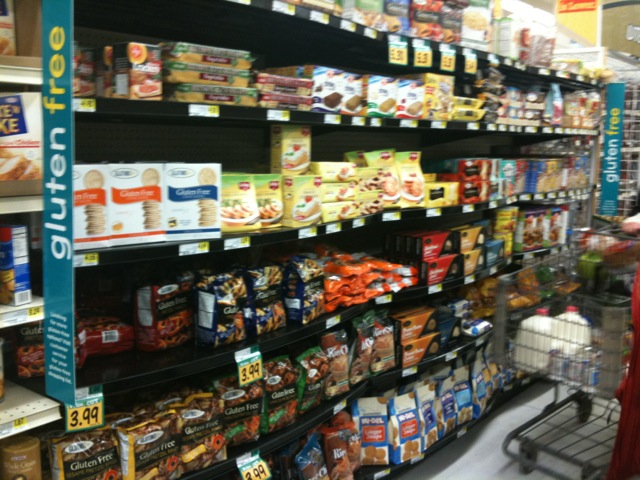 |
| Gluten Free Section at Cub Foods, Blaine, MN |
Do you think it’s on its way to being as mainstream as other $6 billion dollar industries: Halloween, potato chips or Yoga? Feel free to comment below! My take? I think we’ll know it’s mainstream when all schools get behind it as a legitimate healthy diet that people should be able to choose and that it’s worth paying for. Many schools are coming along, but it is very far from being mainstream.
Let’s keep watching over the next few years!
Wednesday, February 2, 2011
Gluten-free has gone mainstream – but how long will that last?

Gluten-free has gone mainstream – but how long will that last?
WENCY LEUNG | From Wednesday's Globe and Mail
Published
In less than five years, sales of gluten-free products have nearly tripled, rising in tandem with the increasing number of new gluten-free goods. Beyond crackers, breads and pastas, it’s now possible to buy everything from gourmet gluten-free cookies at independent bakeries to gluten-free pizzas at restaurant chains such as Boston Pizza.
According to the Rockville, Md.-based research firm Packaged Facts, U.S. retail sales of gluten-free products reached $2.6-billion (U.S.) in 2010, up from $935-million in 2006. And in its 2011 Gluten Free Foods and Beverages report, the firm predicts sales will grow to $5.5-billion by 2015. A similar trend is under way in Canada, although precise national figures are not available.
Full Article>
More Information>
Monday, January 31, 2011
Catering Services on the Rebound, Consumers Seeking Healthier Options
 Though the recession brought a period of famine to the catering
foodservice industry, the feast is at hand as growth initiated in 2010
will continue through 2012 due to aggressive expansion into the catering
space by limited–service establishments, the return of business
event–driven spending, higher wedding spending, and a moderately
healthier consumer, according to “Catering Trends in U.S. Foodservice,” by market research publisher Packaged Facts.
Though the recession brought a period of famine to the catering
foodservice industry, the feast is at hand as growth initiated in 2010
will continue through 2012 due to aggressive expansion into the catering
space by limited–service establishments, the return of business
event–driven spending, higher wedding spending, and a moderately
healthier consumer, according to “Catering Trends in U.S. Foodservice,” by market research publisher Packaged Facts. “Self–standing catering operations dominate sales, but full–service restaurants, limited–service restaurants and snack and beverage concepts also contribute significantly. Driven by aggressive catering launches and expansions, our experts view restaurant–based catering as a growth area into 2012,” says Don Montuori, publisher of Packaged Facts.
Catering revenue exceeded $14 billion in 2010 for an increase of 9% over a stormy 2009. Sales are expected to increase 9% and 7% in 2011 and 2012 respectively. Catering at foodservice and drinking places generated 75% of the catering market size, or $11 billion, in 2010, up 8%. Limited–service establishments are expected to lead catering sales growth through 2012 due to the segment’s ability to leverage moderate menu pricing structures, provide portable fare, and offer in-house operations capabilities.
The recession brought declines in both corporate and consumer spending on catered events. However, Packaged Facts predicts that as the economy continues to recover, businesses will be eager to build revenues again and such eagerness may indirectly fuel the catering business through increased sales meetings, business travel, and convention attendance. Recovery will also spur consumers to entertain with more catered affairs. Weddings, graduations, births, funerals, and other milestones will return as catalysts for consumer spending on catering.
Meanwhile, consumers seeking healthier options have caused a significant change in catering, offering an advantage to companies that highlight the health benefits of their products. Key among these is Subway, which has long promoted the low–fat sub sandwiches on its menu as part of its marketing plans. Other caterers are also seeing a preference for healthier choices, with consumers opting for Greek yogurt, granola, and toasted nuts instead of bagels and donuts, for instance.
More Information> https://www.packagedfacts.com/Catering-Trends-Foodservice-2848313/
[Source: "Catering Trends in U.S. Foodservice," Packaged Facts. 11 Jan. 2011. Web. 18 Jan. 2011.] Full Article: http://www.marketingforecast.com/archives/9777/trackback
Friday, January 14, 2011
Study: Modest Growth in Pet Supplement Sector
Study: Modest Growth in Pet Supplement Sector
 Growth
of pet supplement and nutraceutical treat sales in the U.S. stalled in
2010, but the category is expected to gradually pick back up in the next
five years, according to a report released today by market research
publisher Packaged Facts.
Growth
of pet supplement and nutraceutical treat sales in the U.S. stalled in
2010, but the category is expected to gradually pick back up in the next
five years, according to a report released today by market research
publisher Packaged Facts.“As the economy improves, so should all things pet, but that recovery continues to appear modest,” said David Lummis, senior pet market analyst for Packaged Facts. “Spending on supplements will increase, but restraint will likely continue to characterize how pet owners shop and what they buy during 2011 and even 2012, making value appeals based on pet health, safety, professionalism, practicality, and yes, pricing, more important than ever.”
From 2006 to 2010, sales of pet supplements and nutraceutical treats grew at a compound annual growth rate of about 4 percent, to reach $1.2 billion in 2010, according to the report.
Following zero overall growth in 2010, Packaged Facts forecasts U.S. retail sales of pet supplements and nutraceutical treats to begin to pick back up in 2011, with the annual sales gains regaining steam through 2015. By this account, the annual percentage increases will rise from 2.4 percent in 2011 to 6.5 percent in 2015, lifting sales to approximately $1.6 billion in 2015, according to the report.
Packaged Facts anticipates growth to be considerably faster on the small animal side, which includes dogs, cats, birds, small mammals and herps, than on the equine side, with the compound annual growth rates coming in at 7.4 percent and 2.2 percent, respectively. As a result, small animal is expected to account for 58 percent of the market by 2015, up from 52 percent in 2010.
Tuesday, January 4, 2011
Boulder's Evol, famous for burritos, turning attention toward other frozen foods - Boulder Daily Camera
Posted: 12/26/2010 09:30:00 PM MST
 |
| Jason Espinoza checks the seal on the burrito packaging and racks the burritos for the refrigerator at Evol Foods in Boulder on Dec. 9. ( MARK LEFFINGWELL ) |
A year after the Boulder-bred Phil's Fresh Foods gained some investors and rebranded itself as Evol Burritos (not sinister, it's 'love' spelled backwards), the company changed its name once again. Now operating as Evol Foods, the local manufacturer is launching a line of frozen gluten-free bowl entrees and has grander plans to tackle other sides of the frozen food market, founder Phil Anson said.
"It evolved really quickly into a big overall convenience brand," Anson said. "Over time, we'll be in entrees and you'll see us go into other categories that are as big or bigger than entrees."
What those could be, Anson's not saying right now, just that Evol Foods will broaden its offerings more in the spring and summer.
Although he's staying mum, Anson expressed confidence in Evol Foods' ability to gain a foothold in the sector. Consumers are looking for something fresh, new and different, he claimed.
"That's why we launched Evol," he said. "We really wanted to create a lifestyle brand that people can connect with."
Anson said he also sees a big gap on the meat front, especially in the natural, organic, active and health-focused arena.
"Just because people want natural and organic products doesn't mean they don't want meat," he said.
Evol Foods is expanding in a sector that had "strong" growth during the past five years, but also experienced a slowdown this year.
During 2006 to 2010, sales in the frozen foods and beverages channel increased $10 billion, or 21.7 percent, for a compound annual growth rate of 5 percent, according to an industry report released this month by Packaged Facts. The projected sales gain of 1.7 percent, or $900 million, for 2010 would be the weakest during the period; although, sales gains in the preceding
Jason Espinoza checks the seal on the burrito packaging and racks the burritos for the refrigerator at Evol Foods in Boulder on Dec. 9. ( MARK LEFFINGWELL )
years could have been driven by higher prices, officials for the market research firm said in the report.
While some consumer spending has contracted during the economic downturn, frozen foods have been affected to a lesser extent, according to the report.
"The new economic reality feeds two opposing trends in consumer goods markets, including frozen foods: premiumization (upscaling) and cutting back (downsizing)," Packaged Facts officials wrote in the report. "Rather than canceling each other out, these two trends interact in the face of slow economic recovery as consumers juggle how to get the most out of less money or less spending."
Evol Foods' sales multiplied in 2010, Anson said, noting the company should finish the year up 200 percent from 2009.
The brand's distribution also exploded. As Phil's Fresh Foods, the burritos were sold in 700 stores. Now, as Evol, they are sold in 5,000 to 6,000 locations, he said.
Anson said the key to future expansions -- in sales, products and areas such as food service -- will include his "foodie" mindset and keeping on top of the variety of food-related trends.
"Monitoring what's happening from white tablecloth restaurants to mobile eating, my ears are attuned to all of those things," he said.
Monday, January 3, 2011
Economically Potent and Increasingly Acculturated Latino Consumers Spend More, Display Strong Financial Optimism

"Although suffering their full share of job losses and foreclosures, Hispanic consumers are more optimistic than non–Hispanic white consumers about their own personal financial situation and about the future of the American economy," says Don Montuori, publisher of Packaged Facts. "Between 2008 and 2009 above–average growth in the Hispanic population caused aggregate spending by Latino households to increase slightly even as spending declined in non–Hispanic households. Considering that one in six Americans are now of Hispanic heritage, Latino consumers will remain influential over the ensuing years, especially because there are a significant number of high–income Latino households."
Marketers must be aware of how increasing acculturation will affect the decisions of Latino shopping behaviors. Compared to their low–acculturation counterparts, high–acculturation Latinos are much more likely to own credit cards, take out loans and have health and life insurance, according to the report. They are also less influenced by advertising and product placements but are much more alert to in–store promotions. Additionally, they are far more likely to shop and buy online and from catalogs. Packaged Facts further reveals that more education leads to better paying jobs and increasing influence among high–acculturation Latinos, who are more likely than their low–acculturation counterparts to work as managers and professionals, are more likely to own their own homes, and are twice as likely to have a household income of $75,000 or more.
Although advertising campaigns have increasingly featured Hispanics and Hispanic themes, marketers targeting Hispanic consumers must recognize substantial regional differences in the composition of the Hispanic population. For instance, Latinos living in  western and southwestern states tend to be of Mexican heritage, while Latinos in the Northeast have a much more varied country–of–origin background. With an estimated buying power of $616 billion, Latinos of Mexican heritage represent the single most influential segment of the Hispanic market. Mexicans in the U.S. account for 59% of all Hispanic buying power. On a per capita basis, however, Cubans are the most affluent of the major Hispanic population segments.
Latino Shoppers: Demographic Patterns and Spending Trends among Hispanic Americans, 8th Edition provides an in–depth look at the shopping habits and spending patterns of Hispanic consumers today. It also provides a glimpse into Latino shoppers of the future. As more acculturated Latinos become an ever–larger share of the population, marketers may need to address the potential for a significant change in the profile of the Latino consumer. This Packaged Facts report provides important insights into the way acculturation may affect the shopping behavior and buying decisions of Latinos in the years to come. For further information, please visit: http://www.packagedfacts.com/Latino-Shoppers-Demographic-2848314/.
About Packaged Facts—Packaged Facts, a division of MarketResearch.com, publishes market intelligence on a wide range of consumer market topics, including consumer goods and retailing, foods and beverages, demographics, pet products and services, and financial products. Packaged Facts also offers a full range of custom research services. To learn more, visit: www.packagedfacts.com. Follow us on Facebook, LinkedIn and Twitter.
Sunday, January 2, 2011
A sweet finish to the year
A sweet finish to the year
"They're going out the door as fast as we can make them," said CEO and owner Steven Hegedus, the fourth generation to run the company, as he surveyed the 65,000-square- foot plant. "Business is brisk."
Christmas makes up 35 to 40 percent of annual sales at Abdallah, which manufactures chocolate candies and confections for more than 6,000 gift and specialty food stores across the country, as well as Lunds and Byerly's locally. The company specializes in "everyday chocolate," generally priced lower than most handmade artisan brands, but higher than, say, Hershey's.
If America's sweet tooth provides insight into how consumers feel about the economy, chocolatiers such as Hegedus have some hope for the year ahead.
"We put resources into infrastructure so that when the economy picked up, we'd be poised to be at the next level of production," he said. "That's exactly what's happening now. The recession's not over, but it's picking up."
The $17.3 billion U.S. chocolate industry has expanded, but hasn't regained its prerecession pace of growth, according to consumer market research firm, Packaged Facts. Sales have been resilient mainly because the percentage of Americans who buy chocolate -- 3 out of 4 -- has remained steady.
Industry experts attribute that relative vigor to what economists call the "lipstick factor," where sales of small luxury items stay strong during times of economic hardship because of their ability to lift spirits.
Nonetheless, the recession has forced a handful of chocolate makers in the Twin Cities to become more nimble, and to think of their business in new ways.
Brian McElrath and Christine Walthour, a husband-and-wife team who own wholesaler B.T. McElrath, have completed shifted their business model. A couple of years ago, they manufactured mostly filled chocolates. But in 2009 they boosted production of high-quality chocolate bars.
Wednesday, December 29, 2010
Frozen food trend on the up, says Packaged Facts
By Caroline Scott-Thomas, 23-Dec-2010
"The frozen foods industry in the United States has boomed over the past few years – and growth in the sector looks set to continue in 2011, according to a new report from Packaged Facts."
The market research organization said that the frozen food sector has enjoyed a period of unprecedented growth, as consumers are eating at home more often and manufacturers have innovated with healthier options that also tap into demand for convenience. Packaged Facts’ “Frozen Foods in the U.S., 3rd Edition” report found that from 2006-2010 sales of frozen foods rose 22 percent, or about $10bn, to reach a total value of $56bn in 2010.
Publisher of Packaged Facts Don Montuori said: "A lingering effect of the recession is that consumers are eating at home more. This trend has had a positive impact on the frozen foods market, as consumers turn to the freezer aisles to supplement more expensive fresh produce and meats. Additionally, microwaveable frozen products provide a quick and easy lunch-at-work for those looking to avoid pricey lunches out."
In addition, the report says that the economy is no longer holding back frozen food innovation. After two years of declines, the number of new frozen food and beverage product introductions reached a new high in 2010, increasing 21 percent on the previous year, to 728, more than in pre-recession 2007. The market researcher said this is “a sign that economic conditions are no longer discouraging frozen food marketers from bringing new products to the market.”
While frozen dinners and entrees continued to sell well in 2010, sales of frozen appetizers and snacks are flat, and the frozen juice category is in free-fall, the report said.
“Canned, bottled and frozen juices have all experienced losses in the millions as consumers turn to beverage options with less sugar, or to functional beverages such as energy drinks and enhanced waters,” according to the market researcher.
Packaged Facts predicts that the frozen food and beverage sector will reach $70bn in retail sales by 2015, up 25 percent on 2010.
For further information, please visit: http://www.packagedfacts.com/Frozen-Foods-Edition-2511637/.
A very furry Christmas
A very furry Christmas
"He'll get plenty of toys. He's well-liked," said his adoring owner, Fran Tarr, 83, of Rossmoor, after picking up Benny, a Shih Tzu, from his grooming appointment at the Petco store in Walnut Creek last week. "The family will buy him toys. And I've got two at home that I haven't given him. He's like a little kid."
 |
| Walnut Creek resident Hirsh Morton and his dog, Toshi, visit with Santa Claus recently at Pet Food Express in Walnut Creek. (DAN ROSENSTRAUCH/STAFF ) |
"I think I'll get this little tiger," said McKenzie, 82, of the squeaky toy she purchased for Benny.
Tarr and McKenzie are doing what many holiday shoppers are doing: buying holiday gifts for the furry and not-so-furry.
A survey of pet owners showed that 51 percent of dog owners and 43 percent of cat owners purchased a Christmas present for their animals in 2008, the last year for which data is available from the American Pet Products Association, a trade industry group.
Cats and dogs are not the only pets with something under the tree. About 32 percent of owners of small animals bought their pets holiday gifts, while 31 percent of bird owners, 18 percent of horse owners, 9 percent of reptile owners and 6 parent of fish owners bought their pets holiday gifts, the survey said.
While pets can receive gifts, animal advocates do not recommend buying a pet as a holiday gift for a human. They say too many uncertainties are involved when giving a pet as holiday gift.
The association estimates that Americans will spend $47.74 billion during 2010 on pet food, supplies, veterinary care and buying pets, along with services such as grooming, boarding and pet sitting -- a projected 4.9 percent increase from 2009. (The association does not provide data for holiday gift spending.)
The pet market tends to be recession-resistant, said David Lummis, a senior pet market analyst for Packaged Facts, a division of MarketResearch.com.
Still, Lummis is projecting an overall growth rate of 4 percent in 2010 on U.S. spending for pet products and services, or down from a pre-recession growth rate that was close to 6 percent.
While he does not formally track holiday sales of pet gifts as a component of the pet market, he does expect such sales to be brisk this year.
"It's a good climate in the pet market right now for it to be a good holiday season," he said. "There is pent-up demand. The pet market is largely comprised of above-average income consumers who are more likely to bounce back more quickly from the recession, and also to just generally be less devastated by it."
The survey found that in terms of overall gift giving, dogs receive more gifts than cats do. Eighty percent of dog owners surveyed said they buy presents for their canines, spending an average of $45 throughout 2008 to purchase five gifts. Compare that to 61 percent of cat owners who said they spent an average of $24 throughout 2008 to purchase four gifts for their felines.
"People spend a lot more on dogs than on cats," said Michael Levy, president and founder of Oakland-based Pet Food Express, a chain of 35 pet food and supply stores in Northern California. Dog toys also tend to cost more than those for cats.
"Cat toys are relatively inexpensive. With dog toys, you have more of a range," he said.
One of the most popular gifts this year buy for pets are heated beds, he said. So are puzzle toys, which are designed to hide food or a treat and require the pet to open the toy before eating. Such toys can help dogs deal with separation anxiety, he said. Water fountains are popular gifts for both dogs and cats, he added.
"Northern California tends to be the most sophisticated market for pet products in general in the United States. Pets are truly way more like family than in any other place. "... If you ask people about their pet, they don't stop talking."
People are still talking about the recession, which economists say started in December 2007 and officially ended in June 2009. The poor economy has made some changes in the types of pet gifts that people are buying.
"I think they are buying somewhat more practical (gifts) where perhaps before they buying a lot of fanciful-type stuff, whether it was clothing boutique-type stuff, fancy collars or leashes or maybe that extra-special toy," said Lane Nemeth, founder and chief executive officer of Concord-based Petlane.com, a website that, among other things, sells pet products.
She is also seeing a trend of people buying holiday presents for the pets of relatives and friends, much in the way that McKenzie bought a gift for Tarr's dog.
"People will love you to do death if you bring something for their pet. We are a pet-centric country," she said.
Levy, of Pet Food Express, also is seeing that trend in his stores.
"There are pet grandparents," he said. "Definitely, gift card sales are way up at this time of year."
Choosing a gift for someone's pet also can be an alternative to trying to figure out what to buy for that person, especially if he or she is the type that has everything, Nemeth said.
"So many of us, especially the boomers, we don't want more stuff. So give us something for our pets, and we are happy," she said.
Tuesday, December 14, 2010
Functional, Fortified and Inherently Healthy Foods and Beverages in the U.S., 4th Edition : Packaged Facts

Although the economic recession may prohibit some consumers from purchasing higher-priced specialty items, functional foods can actually save consumers money in the short term by pumping up basic food items with ingredients shoppers would otherwise have to get in the form of more expensive nutritional supplements.
Additionally, whereas in the past consumers were primarily reactive, trying to treat health problems after they arise, today they are more proactive, focusing on overall “wellness” and turning grocery aisles into hunting grounds for healthful, functional foods to prevent illness and chronic conditions.
This fully updated fourth-edition Packaged Facts report examines the U.S. market for functional foods and beverages from all angles while providing insight into key international markets, identifying global trends in new product introductions by geographic region and company and exploring developing markets poised for growth. For the U.S. market, it presents retail sales breakouts of food and beverage categories with a strong functional tilt, from yogurt to food/snack bars to cranberry juice; examines market drivers and trends; and maps out the overall competitive situation. Trends in new product introductions are examined in depth, based on data from Datamonitor’s Product Launch Analytics, as are trends in functional ingredients and condition-specific product thrusts.
The report also profiles major marketers, including Groupe Danone, Kellogg Co., Kraft Foods, Nestlé SA, PepsiCo and Nature’s Path Organic.
An exclusive feature of Functional, Fortified and Inherently Healthy Foods and Beverages in the U.S., 4th Edition is custom survey data from Packaged Facts’ February 2009 online poll of 2,600 U.S. adults, which was conducted to measure purchasing patterns, attitudes and demographics specific to functional foods and beverages. Drilling down to the marketer and brand level, the analysis also relies on consumer survey data from Experian Simmons’ Fall 2008 National Consumer Study, and on Information Resources, Inc. InfoScan Review data charting product sales in mass-market channels.
MORE
Friday, December 10, 2010
Mmm, Chocolate

By Joanna Cosgrove, Nutraceuticals World, Published December 9, 2010
“Over the last decade chocolate makers have been responding to consumers’ drive to live healthier lifestyles,” commented Packaged Facts’ Curtis Vreeland, a seasoned chocolate industry analyst and author of the report. “Their efforts have brought us portion-controlled packaging, sugar-free sweets, heart-healthy dark chocolate and fortified confections of unbelievable variety and veracity. This trend should continue, as healthier confectionery offers consumers an irresistible package: health and wellness, plus indulgence and a convenient serving modality.”
__
Read Full Article
Hispanic Food and Beverages in the U.S.: Market and Consumer Trends in Latino Cuisine
|
||