Search This Blog

Showing posts with label grocery. Show all posts

Friday, March 25, 2011

MediaPost Publications Extreme Flavors Getting More Extreme 03/25/2011

Yuzu-Ranger
Extreme Flavors Getting More Extreme by Karlene Lukovitz


Like a sprig of Douglas fir in that martini? How about a sea buckthorn berry tart?

As a Wall Street Journal article declared last year, American cuisine is "adrenaline cuisine." Increasingly, that means getting sensory thrills through "extreme and edgy" tastes that push the limits of hot, sweet, salty, sour and bitter, confirms a new Center for Culinary Development (CCD) culinary trend report, published by Packaged Facts.

And yes, while you're not likely to be seeing them in your frozen entrée or dessert sections in the near future, the Douglas evergreen and sea buckthorn -- a "superfruit" berry native to Asia and Europe -- are the latest extreme flavors establishing a foothold in North American cuisine, according to CCD.

Adventurous chefs and mixologists have been using the aromatic Douglas in meat dishes, sauces, drinks and desserts for a few years, and home chefs are now picking it up at farmers' markets -- part of a trend termed "foraging" or "wildcrafting," reports CCD.

The bright orange, intensely tangy sea buckthorn, meanwhile (acai is so 2010), is already hot in Canada, as it's being cultivated in Quebec and Saskatchewan. In addition to being served as a dessert, chefs use it as a substitute for common citrus fruits in foods such as sorbet and curd.

Other extreme or edgy foods/tastes making their way through the five trend stages described by CCD (Douglas and sea buckthorn are at the earliest, or first stage):
  • Yuzu: an exotic Japanese citrus fruit with a simultaneously floral and tart flavor that's now being seen not only in fine dining restaurants but in specialty food markets, in products including soft drinks, sauces, condiments, savory snacks, confections and frozen desserts.
  • Bitter brews: Italian amari spirits are trendy as pre- and post-dinner drinks, cocktail bitters are big in retro drinks, and craft-brewed "hoppy" India Pale Ales are increasingly popular. (Example of the last: New Belgium's quickly growing Ranger IPA label.) Like yuzu, CCD puts bitter brews at the stage two trend level.
  • Tamarind: A key ingredient in Pad Thai, and now increasingly found in many specialty retail foods and pan-Asian and pan-Latin chain restaurants (putting it at stage 3).
  • Chocolate and chile: This hot-and-sweet combo sensation is well along the trend curve (stage four), and already appearing in recipes in popular women's magazines. That makes it ripe for inclusion in packaged baked goods, mainstream drink mixes and confections, and in-store bakery offerings, says CCD.
  • Wasabi: This hot, horseradish-like plant is already more or less mainstream (stage five). It's become a common ingredient in mashed potatoes, hummus, dressings and other dishes, and is also showing up in snacks and comfort foods, according to CCD.

MediaPost Publications Extreme Flavors Getting More Extreme 03/25/2011

Wednesday, March 23, 2011

As boomers turn 50 and enter their 60s, they are carrying with them a firm belief that getting older means getting better and they are making health and wellness a top priority.

Healthy 50+ Americans: Trends and Opportunities in the Emerging Wellness Market

New Research Study: Healthy 50+ Americans: Trends and Opportunities in the Emerging Wellness Market

As boomers turn 50 and enter their 60s, they are carrying with them a firm belief that getting older means getting better and they are making health and wellness a top priority.

Today, large food companies are exercising strategic focus on boomers by introducing foods that enhance their health and vitality. Beverage companies are following suit with new juice and dairy- and yogurt-type drinks that enhance immune function.

Why such focus on this cohort? Besides the growing population size and large bank accounts, Packaged Facts' exclusive survey data reveals that healthy consumers 50+ are far more likely to reach into their wallets to pay extra for "better-for you" grocery products when compared to their peers in the same age group.

Food and beverage marketers will benefit from the analyzes and insight inside this brand-new research study. In addition to taking advantage of the latest trends and opportunities in the emerging wellness market you will:

  • Uncover the eating habits and attitudes of healthy 50+ Americans toward calorie counts, food and beverage choices, and managing nutrition.

  • Learn what this cohort is doing to stay healthy, hint: they prefer alternative and homeopathic medicine.

  • Craft business plans with our buying power forecast through 2015.

  • Understand the healthy 50+ American with our detailed analysis including education, finances, core values and leisure and entertainment choices.

  • Discover how this demographic will have the biggest impact on your bottom line in the five years ahead.

More information:
Price/Info   |   Table of Contents   |   Place an Order

Tuesday, March 15, 2011

QSR Magazine: What Happened to Table Service?

What Happened to Table Service?

The recession served casual-dining chains some serious blows. But quick serves and fast casuals shouldn’t get too confident. 
Table service restaurants are struggling as they balance price and menu options.

In many cases, it’s a different consumer out there today deciding where to dine when the urge hits. Throughout the recession, full-service restaurants offered so many fire-sale bargains that those little affected by the economy could almost feel guilty for practically stealing meals when they would have just as willingly paid regular price.

The meal deals that spelled survival for sit-down restaurants were like Black Friday to consumers, says David Morris, author of the report Dinner Trends in the U.S. Foodservice Market for Packaged Facts. The upshot was giddy guests (higher guest traffic) with lower guest checks. Great for the consumer, but depressing for operators who are now trying to unwind themselves from the spiral.
[CONT.]

The Cold Standard


By Jennifer Strailey
The frozen case offers a host of hot trends in natural and organic foods.

One of last year's hottest food and beverage trends came out of the supermarket freezer case, and, given the current economic outlook and consumer shopping habits, industry analysts believe this cold front has moved in for the long stretch.
U.S. retail sales of frozen foods and beverages through all retail channels totaled $55.9 billion in 2010, up 1.7 percent from the previous year, according to Packaged Facts, a division of MarketResearch.com, in its recently released report, "Frozen Foods in the U.S., 3rd Edition" (January 2011). The consumer market research firm, based in Rockville, Md., expects that number to reach $70 billion in 2015.
There's no question that frozen food sales have been driven in part by the economy, which has seen a decline in Americans dining out in favor of eating at home. Frozen foods provide a more affordable alternative to eating out, while at the same time satisfying consumers' eternal craving for convenience. But more recently, manufacturers have introduced a slew of natural, organic and wellness-oriented frozen food and beverage products that has brought attention — and health cred — to the category like never before.

Wednesday, March 9, 2011

5 Hygiene Products Every Man Should Have

It's a common misconception that men don't care about hygiene products. While you may not want to smell like a rose, no one wants bad breath or body odor. In fact, the market for men's skin care and hygiene products -- which was valued at approximately $20 billion worldwide in 2009 -- is rapidly growing, and predicted to reach $28 billion by 2014.

Competition on Aisle Five

Competition on Aisle Five
A new study finds consumers are flocking to grocery-store prepared meals for two reasons. And restaurants should be worried.
 

Quick-service restaurants feeling more intense competition for the consumer’s dollar might not only look at their dining rivals across the street, but their supermarket down the block.

A growing array of prepared and ready-to-eat foods at retail outlets such as Walmart and Kroger are attracting consumers and threatening to put a dent in quick-service business, says a new report from Packaged Facts titled “Prepared Foods and Ready-to-Eat Foods at Retail: The New Competition to Foodservice.”

Tuesday, March 8, 2011

Report: Gluten-Free Momentum Accelerating

Photo Source: MediaPost Publications
by Karlene Lukovitz, Friday, March 4, 2011, 5:41 PM
 
Sales of gluten-free foods and beverages, once considered specialty items, had a compound annual growth rate of 30% in the U.S. between 2006 and 2010, according to the latest report on this category from research publisher Packaged Facts.

Packaged Facts, which previously projected that sales of gluten-free foods and beverages would reach $2.3 billion by 2011, has revised those estimates, putting the market at $2.64 billion in 2010.

Moreover, despite factors such as expected falling product prices due to a greater presence of these items in mass outlets and more private-label choices, the researcher expects gluten-free products to show average annual compound growth of 14% between 2011 and 2015, to reach sales of to $5.6 billion by 2015.

The dynamics behind this growth start with growing consumer awareness of celiac disease -- a chronic autoimmune intestinal disorder in genetically susceptible individuals that causes a toxic reaction to ingesting wheat gluten and similar proteins. A Mayo Clinic study found that the rate of celiac disease has more than quadrupled in the past 50 years -- this despite the fact that it is still "staggeringly under-diagnosed," according to Packaged Facts. Recent estimates are that 1% of Americans, or about 3 million people, may be affected. Food allergies affect about 4% of U.S. adults and 5% of children, and the incidence among children, in particular, has been rising rapidly.

Currently, the only treatment for celiac disease is lifelong adherence to a gluten-free diet -- which is why, these days, "everyone knows someone" who is living gluten-free, one marketer noted to the report's researchers. In addition, there is evidence that gluten-free diets may relieve autism in children and adult rheumatoid arthritis.
Furthermore, from a broader perspective, a growing number of consumers perceive gluten-free products as being of higher quality and having a healthy "aura" -- a dynamic similar to the one that's driven sales growth of kosher foods in recent years, points out the report. "There is a demand for [gluten-free] foods and beverages that mainstream food manufacturers and retailers are increasingly happy to satisfy," observes Don Montuori, publisher of Packaged Facts.

Recognition by major brands and mass retailers of the sustainable -- non-fad -- growth of gluten-free products, and their resulting push to market/carry such products, has resulted in health food stores' share of these products' sales dropping by half in just two years, estimates Packaged Facts. The surge in the sales and number of products specifically marketed as gluten-free in supermarkets and mass merchandisers tracked by Symphony IRI has reached the point that, according to one brand marketer quoted in the report, gluten-free products are becoming "just a regular grocery item."

Dominant gluten-free product categories in food/drug/mass retailers include food/nutrition bars -- which, largely due to General Mills' acquisition of the Lärabar brand in 2008, represent about 16% of total gluten-free product sales in these outlets and showed the largest year-over-year sales growth between 2009 and 2010, according to the report. Sales of gluten-free ready-to-eat cereals declined slightly between 2009 and 2010, but that category remains in second place.

Indeed, General Mills' "transformation" of its popular Rice Chex cereal into a gluten-free product without changing its taste "stands as a milestone indicator of the breadth of impact of gluten-free products having mainstream consciousness," point out Packaged Facts' analysts. As of November 2010, General Mills reported offering 250 gluten-free products, including five varieties of Chex and numerous products under the Betty Crocker and Bisquick brands.

Meanwhile, while product categories such as hot cereal, soups and frozen pizza are still very small segments of the overall gluten-free food/beverage market, they are showing significant, double-digit gains.
Consumers on gluten-free diets are willing to pay the higher prices generally associated with gluten-free products, the report notes.

Friday, February 4, 2011

Gluten Free Gone Mainstream?

Source: http://thesavvyceliac.com/2011/02/02/gluten-free-gone-mainstream/

Going “mainstream” for gluten free foods may have a different meaning for everyone.  For restaurants, it may just mean putting together a  gluten free menu (regardless of education), for grocery stores it may mean putting it in the main aisles (and the employees know what you’re talking about if you ask them a question), but for me it’s all of the above and more — including a good basic public awareness on what it really means.

That could be the case if new product survey which looks ahead a few years is accurate. According to a news release for “Gluten-Free Foods and Beverages in the U.S., 3rd Edition” by market research publisher Packaged Facts, the gluten-free market is currently a $2.6 billion dollar industry.  It reports it will likely double to about $6 billion by 2015!  $6 billion is similar to the current industries of  Yoga, Halloween, and Potato Chips!  What’s more mainstream than Halloween and potato chips (well maybe not together).  But even if you look at Yoga, I think one might consider that when it started as a fitness regime in the US, it wasn’t considered mainstream and look where it is today!
Could gluten-free food be the next Yoga?
Well, that answer remains to be seen– but the survey showed, “The #1 motivation for buying gluten-free food products is that they are deemed healthier than their conventional counterparts.”  Don Montuori, publisher of Packaged Facts is quoted in the release, “…there is evidence suggested that eliminating gluten from the diet may relieve autism in children and adult rheumatoid arthritis. Add to that the healthy ‘aura’ some consumers have attached to gluten-free products, and you create a demand for these foods and beverages that mainstream food manufacturers and retailers are increasingly happy to satisfy.”
People are buying gluten-free to treat celiac, autism or some other ailment but also as a healthy kick to their diet.  I do think the healthy gluten-free “fad”  has benefited those in the celiac world– not so much with education regarding a correct gluten-free diet, but rather in selection for foods for us.
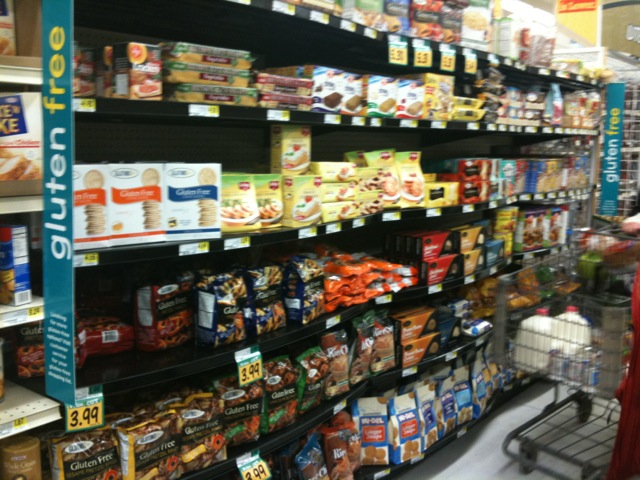
Gluten Free Section at Cub Foods, Blaine, MN

More evidence of the “mainstreaming trend” (according to the the news release) is  “the notable shift in the retail distribution of gluten-free products from specialty stores to chains. The surge in the sales and number of dedicated gluten-free products carried by the supermarkets and mass merchandisers demonstrates that gluten-free is becoming, as one marketer interviewed by Packaged Facts in the report states, ‘just a regular grocery item.’”  I’ll believe that when I see it.  I don’t think that’s nearly the case yet.  But it the shift is true– my local Cub Foods was a prime example when they expanded their gluten-free section and put it in the mainstream section earlier this month.

Do you think it’s on its way  to being as mainstream as other $6 billion dollar industries:  Halloween, potato chips or Yoga?  Feel free to comment below!  My take?  I think we’ll know it’s mainstream when all schools get behind it as a legitimate healthy diet that people should be able to choose and that it’s worth paying for.  Many schools are coming along, but it is very far from being mainstream.

Let’s keep watching over the next few years!

Thursday, February 3, 2011

High Quality Prepared Food Departments Add Dine-in Cafes to Drive Traffic at Grocery Stores


Prepared food bar at Wegmans.  Photo Courtesy of
toujourspretamanger.com
Been to a Wegmans lately?  The Market CafĂ©s have pizza, freshly-made sushi, burritos, Thai food, and vegetarian choices for dining in or taking home. And Kroger took out the underused salad bars to make way for prepackaged salads, sandwiches, and carnitas. My own local Harris Teeter offers chef-staffed prepared food stations.  Imagine that, a live person ready to make my perfect California roll.

As a self-proclaimed 'foodie' you would think I'd stick to the trendy new restaurants in downtown D.C. But on today’s shoestring budget that’s not possible.  Instead, I find myself eating what I want at attractive, upscale bistro area of my local grocery store.

The traditional grocery channel made 57% of retail food & beverage dollar sales in 2010, according to market research publisher Packaged Facts. Through their in-store foodservice options, traditional grocery stores stand to further grow in share of U.S. food & beverage sales.


Grocery stores are aiming to make shopping more appealing by providing upscale restaurant-like experiences to customers. In order to attract as many shoppers as possible, stores are providing a wide range of restaurant-style foods and amenities: wood-fired pizzas, made-to-order soups, sandwich and sushi bars, and dining areas. And the eager (read: hungry) shoppers who want to grab a quick meal while grabbing the groceries, take a break for lunch, or get a snack before the drive or walk back home are eating it up.

Packaged Facts analysis expects to see food retailing and foodservice channels continue to converge around fresh prepared foods, working fervently to make consumption more convenient. As a result, the competitive lines between grocery stores, restaurants, convenience stores, and other channels will continue to blur in a U.S. food & beverage retail market projected by Packaged Facts to reach nearly $700 billion by 2015.

At the end of the day, when the sushi stand has been cleaned and the fresh olive bar has closed, what else will retailers be looking to add? Besides adding to their variety of on-the-go foods, deli and prepared food departments will expand with easily accessible take-out entrances and check-out lanes; curbside pick-up and call-ahead ordering; website and smart phone apps for ordering.

Well, that’s where its heading, but for me its lunch-time and I’m heading over to the Parisian cafĂ© at my local Whole Foods Market. Or maybe a grilled vegetable sub at Teeters? I could really go for some sushi-…

Wednesday, February 2, 2011

Gluten-free has gone mainstream – but how long will that last?

Gluten-free has gone mainstream – but how long will that last?

WENCY LEUNG | From Wednesday's Globe and Mail


In less than five years, sales of gluten-free products have nearly tripled, rising in tandem with the increasing number of new gluten-free goods. Beyond crackers, breads and pastas, it’s now possible to buy everything from gourmet gluten-free cookies at independent bakeries to gluten-free pizzas at restaurant chains such as Boston Pizza.

According to the Rockville, Md.-based research firm Packaged Facts, U.S. retail sales of gluten-free products reached $2.6-billion (U.S.) in 2010, up from $935-million in 2006. And in its 2011 Gluten Free Foods and Beverages report, the firm predicts sales will grow to $5.5-billion by 2015. A similar trend is under way in Canada, although precise national figures are not available. 

Full Article>

More Information>

Wednesday, November 10, 2010

Frozen food manuf. find themselves in spot during the recession

Marketers of frozen convenience food have found themselves caught between a rock and a hard place during the economic downturn. Though fresh convenience food has gained through positioning that casts it as a less expensive alternative to restaurant food during a time of recession, frozen convenience food is frequently viewed as a more expensive, less fresh alternative to cooking from scratch at home. The frozen food categories that have been able to grow substantially in this environment are therefore the ones that have been able to elude this paradigm.
Specifically, the mammoth frozen pizza category and the spunky hand-held breakfast category have both found a way to go head-to-head with restaurants; and the prepared vegetable category has been able to triumph on the freshness front via the development of steaming techniques. According to Packaged Facts, these three categories have led the way sales-wise, enabling an otherwise ambivalent market for frozen convenience foods to grow by a modest 2.0% in 2010 to reach sales of $16.8 billion. Packaged Facts expects that marketers in other categories will soon adopt similar strategies, driving sales of fresh convenience foods up another 10% by 2015, to $18.6 billion.

Frozen Convenience Foods in the U.S. : Packaged Facts

Monday, October 25, 2010

students are 60% more likely than average to have dinner foodservice at a grocery store or supermarket

As part of our foodservice reports series, we’ve paid close attention to the increasing competition restaurants face from food retail prepared foods. According to Dinner Trends in U.S. Foodservice (October 2010), prepared foods are succeeding with students, who are limited-service restaurant stalwarts. Our proprietary consumer research indicates that students are 60% more likely than average to have dinner foodservice at a grocery store or supermarket, and about 40% more likely than average to have dinner at a convenience store/gas station.
So, while students may not go grocery shopping as often or spend as much there as consumers who have more established households, they clearly respond to convenience-minded offerings when they visit. We believe this provides significant opportunity for food retailers, not just because students are generally more convenience-driven but also because they are more health-conscious. As a group, students may be prone to say they want healthier fare and then make contrarian food decisions—a function of impulse, cost-considerations and the metabolic hubris of youth. But as more and more university foodservice programs have come to understand, students will embrace more healthful options if they meet cost and quality parameters—and the supermarket is optimally positioned to leverage own-branding to provide healthful fare.

But the most significant benefits may run longer-term. Having grown up during what we have coined “The Restaurant Age,” students aged 18-24 are as far removed from routine grocery shopping (and home cooking) as any generation before them. By providing prepared foods that meet their needs, food retailers not only drive a wedge between students and restaurants; they can also leverage that wedge to bring them into the home-cooking fold, by educating on meal planning and meal budgeting, or by using the prepared foods space as a bridge to introduce easy-to-cook meals that blend old-fashioned standards such as mac-and-cheese and spaghetti with new-found international and/or aspirational ingredients—for a reasonable cost, of course.More>

Friday, September 24, 2010

Pet Supplies and Pet Care Products: The U.S. Market and a Global Perspective

Even as the economic picture improves, consumers remain cautious about spending, including in terms of the pet products they buy. Having lived up to its “recession-resistant” reputation once again, the business therefore continues to face challenges that have retailers, marketers and product developers relying more heavily than ever before on the all-important notion of pets as family. Accordingly, themes including health, function, comfort, safety, gifting, travel, and yes pet pampering are all weighing heavily on the value scale as market participants look to strike the perfect balance in pet categories across the board.
Tapping into Packaged Facts’ extensive pet market report collection and analyst expertise, Pet Supplies and Pet Care Products in the U.S., 8th Edition: Pet Health and Pampering: The New Value Equation provides detailed market breakouts and insights not available elsewhere. Covering non-food pet supplies of all types and for all companion animal types, the report examines trends in flea/tick care products, cat litter, toys, rawhide chews, bedding, grooming products, supplements, clean-up products and many other product segments. Using 2009 as the base year, it charts sales since 2005 and forecasts sales through 2014; breaks the market out by animal type and product category in both the mass-market and pet specialty channels; presents dollar sales and market share for leading marketers and brands; analyzes competitive strategies and shifts; profiles top companies and market innovators; analyzes new product trends; and provides demographic and psychographic profiles of product purchasers.

More Information>>

Food Flavor and Ingredients Outlook 2010, 7th Edition

While Wall Street claims that the recession has ended, Main Street will continue to face financial challenges through most, if not all, of 2010. Frugal behaviors consumers adopted in 2009 are becoming engrained and reflect a new normal when it comes to shopping, dining and eating preferences for the foreseeable future. What constitutes value is being redefined and consumers are starting to make different choices than in years past that will drive their food and beverage purchases. Food Flavors and Ingredients Outlook 2010 describes the trends that Packaged Facts predicts will influence the flavors and ingredients that will drive food and beverage selection at retail and in restaurants and other foodservice establishments in the coming year and beyond.
 
The 2010 edition of this annual report (which was first published in 2004) includes coverage of eight primary focus areas impacting flavor and ingredient trends. To assess the shift in trends over time, predictions for last year are summarized along with Packaged Facts’ expectations for 2010 in relation to:

  • International Flavors
  • Redefining Healthy Eating
  • Local Food Production and Sourcing
  • Reenacted Flavors
  • Savory Trends
  • Sweet Trends
More Information>>

Monday, September 20, 2010

NEW! Artisan Foods: Culinary Trend Mapping Report

Artisan foods are everywhere, from their pervasive presence at large chain grocery store bakeries featuring in-house baked “artisan” loaves to fast casual chains such as Panera Bakery that have built an entire sandwich menu around freshly baked breads.

Manufacturers and restaurant operators have recognized that “artisan” has become another term for “quality.” It evokes small producers making traditional foods by hand, treating production as a craft and putting great care into the outcome. Larger producers are able to capture the aura of artisan with rustic-looking products, distinctive ingredients, unique cooking methods and stories that connect products to consumers.
 
This report explores the possibilities available in the world of artisan foods, and tracks some of the most exciting contemporary trends associated with this popular culinary segment.
Many artisans source their ingredients from nearby farms or grow their own, making a concerted effort to only use what’s available and in season to create a high quality, fresh-tasting product. Consumers savor these regional specialties and unique flavors. Artisan foods give consumers sustenance with a story featuring products that are more authentic and less conventional. For consumers it’s as much about nostalgia as it is about security in knowing they are feeding their families quality cuisine. Modern day artisans specialize and innovate on the traditional, producing savory and exotic ice creams, unusual types of cheese or specialized spirits to enliven and entice the palate. Like modern street food vendors, artisans make process part of their product, offering consumers a window into the traditions of the past. The current wave of artisan foodmakers is making the environment a priority, employing business strategies that minimize waste and negative impact on the earth. Reusable containers, compostable packaging and other eco-friendly practices allow consumers to be socially responsible while also enjoying an excellent product.
  • Local & Seasonal Eating —
  • Homemade/Authentic —
  • Flavor Adventure —
  • Consumer Engagement —
  • Going Green —
More Information>>

Sunday, September 19, 2010

Prepared Foods and Ready-to-Eat Foods at Retail: The New Competition to Foodservice

Wegmans Cafe
Hoping to parlay recession-based foodservice-to-retail migration into long-term gains, food retailers continue to ratchet up their prepared foods and ready-to-eat programs. Packaged Facts estimates that grocery stores and supermarkets will grow prepared- and ready-to-eat foods sales by more than 7% in 2010. Their usage imprint is already imposing:

According to Packaged Facts’ proprietary consumer research, 64% of adult consumers have gotten ready-to-eat/heat-and-eat food from a grocery store or supermarket in the last month. Moreover, in terms of total usage occasions, grocery-related prepared foods use leads both family and casual restaurant segments and trails only fast food/QSR.
 
While convenience stores have also relied heavily on prepared foods and foodservice sales for sales and higher margins, increasing competition extends to supercenters, warehouse clubs, convenience stores and drug stores. At a time when food value is so closely associated with low cost and convenience—and when consumers increasingly perceive private label food retail brands as competitive with name brands on cost and quality—prepared and ready-to-eat foods programs that deliver on quality, taste and convenience can not only compete with foodservice fare, but can also help food retailers adapt to modern consumer lifestyles.

More Information>>

Friday, September 17, 2010

Gluten-free has gone big time, but why so popular?

09/16/2010 - Michael Hill - Associated Press


This July 5, 2005 file photo shows gluten-free products on
display at a Hannaford Supermarket in Albany, N.Y. U.S.
sales of gluten-free food has more than doubled
since 2005 to over $1.5 billion, according to the market research
company Packaged Facts. And the growth spurt
is expected to continue at least through 2012.
(AP Photo/Jim McKnight, FILE)
Gwyneth Paltrow gushes over gluten-free. Chelsea Clinton's wedding cake was baked without it. The new Old Spice guy avoids the ubiquitous protein to help stay buff. In fact, odds are good you too have tried — or at least encountered — a product with the gluten removed.

Because gluten-free is what low-carb was a decade ago: The "it" diet discussed on daytime talk shows, promoted by hyper-slim actresses and adopted by masses. Grocery aisles are stocked with the likes of gluten-free pasta, crackers, cereal and beer.

Americans are enthusiastically exiling a dietary staple that wasn't even in most people's vocabulary a decade ago.

But why?

Unlike some other dietary boogeymen like trans-fats, gluten is not inherently bad to eat. Only a small percentage of people can't tolerate the protein, which occurs naturally in wheat, barley and rye. Plus, banning gluten from your diet can be really hard.

Not only is gluten an essential element of traditional breads and pastas (it's the protein that gives them their structure), it often is used as a thickening agent in processed foods, such as ketchup and ice cream. And cutting out gluten is no guarantee of weight loss.

Tuesday, September 14, 2010

New sandwiches meet consumer interests, values

Sandwiches aren't just an important part of the American diet; they are essential to it. And lucky for hungry consumers, sandwiches are undergoing exciting flavor and quality upgrades on every level -- carriers, fillings and condiments.

New sandwich trends are driven by artisan and sustainable ingredients, American regional and global flavor profiles, and even better nutrition, according to the "Sandwiches: Culinary Trend Mapping Report" from the Center for Culinary Development (CCD) and market research publisher Packaged Facts.
Read Full Article>

Competition on Aisle Five

A new study finds consumers are flocking to grocery-store prepared meals for two reasons. And restaurants should be worried.

By Daniel P. Smith - QSR Magazine

Quick-service restaurants feeling more intense competition for the consumer’s dollar might not only look at their dining rivals across the street, but their supermarket down the block.


A growing array of prepared and ready-to-eat foods at retail outlets such as Walmart and Kroger are attracting consumers and threatening to put a dent in quick-service business, says a new report from Packaged Facts titled “Prepared Foods and Ready-to-Eat Foods at Retail: The New Competition to Foodservice.”

The report surveyed 1,881 U.S. adult consumers and found that half of respondents were more likely to eat dinner at home than they were three months ago, while 64 percent reported purchasing ready-to-eat or heat-and-eat food from a grocery store within the last month. The study predicts that supermarket prepared foods will grow to $14 billion by 2011, largely motivated by consumers migrating away from restaurants during the recession in search of value and one-stop-shop convenience.

“We see a lot of momentum here and expect growth of 7 percent from 2010 to 2011, which is a pretty monumental surge in a supermarket industry that has been accustomed to losing share,” says David Morris, the report’s chief analyst.

The study cites two distinct groups gobbling up supermarket-prepared foods: those who seek low-cost, quick alternatives out of necessity or convenience and those who see the prepared foods as an alternative to home cooking. Both groups have long been primary clientele for the quick-service category, heightening restaurant concerns in an already challenging environment.

“This is not a new trend, but we do see this as the year that grocery stores put this strategy at the forefront, which should be a competitive concern for restaurants,” Morris says.

Suzanne Long, a grocery retail analyst with New York–based SSA & Company, says grocery stores began stocking prepared meals more aggressively in 2005–2006. Noting a consumer conscious of price and time, the industry saw an opportunity to modernize its decades-old business model and push into new areas. Offering prepared meals was supposed to generate additional in-store purchases.

“There’s been a huge trend toward this for years now, but the retailers are looking far more at sales and market share over profit,” Long says.

Although still in its formative years, the prepared-meals trend is gaining momentum, particularly as the recession lags. Grocery chains continue to experiment with more diverse offerings, portion size, and operational efficiencies to better compete with restaurants and draw customers.

“Grocery stores feel as if they haven’t come close to achieving their goal of grabbing greater market share, so there’s absolutely a continued push,” Long says.

The study predicts that supermarket prepared foods will grow to $14 billion by 2011.While the threat of increased competition in an already heated foodservice field brings concern to some restaurant brands, others see the rise of grocery stores in the prepared-foods arena as a complement—not a competitor—to business.

In June, Canadian chain Tim Hortons announced it would add 48 self-service coffee kiosks to new Tops Friendly Markets locations in the northeast U.S. The partnership adds to Tim Hortons’ already strong relationship with the grocer, which includes existing kiosks in 82 Tops outlets in upstate New York. Each of the locations serves Tim Hortons’ signature blend coffee, Timbits donut holes, hot chocolate, and tea.

“We’re taking the brand to the people,” says Tim Hortons COO David Clanachan. “The key thing is convenience. People are time-starved and they want what they want. If we make our products available and win loyal customers, then it feeds our brand.”

Whether competitor or complement, there remains little question that grocery’s major players intend to challenge restaurants. While grocery stores might succeed and expand in the short term, Morris sees a ceiling to their market share.

“The grocery stores cannot be ignored, but they still cannot recreate the restaurant experience unless they build out and create their own branded restaurant-like setting,” he says. “That’s one thing the restaurant world has going for it, even as the competition grows.”

For information on Prepared Foods and Ready-to-Eat Foods at Retail: The New Competition to Foodservice click here.