Search This Blog

Showing posts with label gluten free. Show all posts

Thursday, April 28, 2011

Baked Goods: Culinary Trend Mapping Report

For the past several years, consumers have been soothing themselves with all manners of baked goods, ranging from freshly made pies and Parisian macarons to decadent cookies and oozing lava cakes - all while enjoying new twists on old favorites as well as a more varied selection of baked goods and flavors.

Despite recent economic difficulties, baked goods generally remain an affordable indulgence, and one consumers can access in many places. The recession hasn't prevented sales of baked goods from growing, as the market has been pushed by a variety of drivers: convenience, premium ingredients, global flavor twists, wellness and nostalgia/comfort.
 
In Baked Goods: Culinary Trend Mapping Report, Packaged Facts and the Center for Culinary Development use the CCD signature Trend Mapping technique to profile seven sweet and savory baked good trends that provide fresh ideas for manufacturers and restaurant operators to enliven stale offerings, spruce up the bread basket and add excitement to both the baking aisle and freezer case.
The seven sweet and savory baked good trends appearing across the Trend Map® include:
  • Stage 1: The Micropatisserie
  • Stage 1: Alfajores
  • Stage 2: Popovers & Gougres
  • Stage 3: Specialty Frozen Desserts
  • Stage 3: Better Baking Mixes
  • Stage 4: Pretzel-mania
  • Stage 5: Gone Gluten-Free

Tuesday, March 8, 2011

Report: Gluten-Free Momentum Accelerating

Photo Source: MediaPost Publications
by Karlene Lukovitz, Friday, March 4, 2011, 5:41 PM
 
Sales of gluten-free foods and beverages, once considered specialty items, had a compound annual growth rate of 30% in the U.S. between 2006 and 2010, according to the latest report on this category from research publisher Packaged Facts.

Packaged Facts, which previously projected that sales of gluten-free foods and beverages would reach $2.3 billion by 2011, has revised those estimates, putting the market at $2.64 billion in 2010.

Moreover, despite factors such as expected falling product prices due to a greater presence of these items in mass outlets and more private-label choices, the researcher expects gluten-free products to show average annual compound growth of 14% between 2011 and 2015, to reach sales of to $5.6 billion by 2015.

The dynamics behind this growth start with growing consumer awareness of celiac disease -- a chronic autoimmune intestinal disorder in genetically susceptible individuals that causes a toxic reaction to ingesting wheat gluten and similar proteins. A Mayo Clinic study found that the rate of celiac disease has more than quadrupled in the past 50 years -- this despite the fact that it is still "staggeringly under-diagnosed," according to Packaged Facts. Recent estimates are that 1% of Americans, or about 3 million people, may be affected. Food allergies affect about 4% of U.S. adults and 5% of children, and the incidence among children, in particular, has been rising rapidly.

Currently, the only treatment for celiac disease is lifelong adherence to a gluten-free diet -- which is why, these days, "everyone knows someone" who is living gluten-free, one marketer noted to the report's researchers. In addition, there is evidence that gluten-free diets may relieve autism in children and adult rheumatoid arthritis.
Furthermore, from a broader perspective, a growing number of consumers perceive gluten-free products as being of higher quality and having a healthy "aura" -- a dynamic similar to the one that's driven sales growth of kosher foods in recent years, points out the report. "There is a demand for [gluten-free] foods and beverages that mainstream food manufacturers and retailers are increasingly happy to satisfy," observes Don Montuori, publisher of Packaged Facts.

Recognition by major brands and mass retailers of the sustainable -- non-fad -- growth of gluten-free products, and their resulting push to market/carry such products, has resulted in health food stores' share of these products' sales dropping by half in just two years, estimates Packaged Facts. The surge in the sales and number of products specifically marketed as gluten-free in supermarkets and mass merchandisers tracked by Symphony IRI has reached the point that, according to one brand marketer quoted in the report, gluten-free products are becoming "just a regular grocery item."

Dominant gluten-free product categories in food/drug/mass retailers include food/nutrition bars -- which, largely due to General Mills' acquisition of the Lärabar brand in 2008, represent about 16% of total gluten-free product sales in these outlets and showed the largest year-over-year sales growth between 2009 and 2010, according to the report. Sales of gluten-free ready-to-eat cereals declined slightly between 2009 and 2010, but that category remains in second place.

Indeed, General Mills' "transformation" of its popular Rice Chex cereal into a gluten-free product without changing its taste "stands as a milestone indicator of the breadth of impact of gluten-free products having mainstream consciousness," point out Packaged Facts' analysts. As of November 2010, General Mills reported offering 250 gluten-free products, including five varieties of Chex and numerous products under the Betty Crocker and Bisquick brands.

Meanwhile, while product categories such as hot cereal, soups and frozen pizza are still very small segments of the overall gluten-free food/beverage market, they are showing significant, double-digit gains.
Consumers on gluten-free diets are willing to pay the higher prices generally associated with gluten-free products, the report notes.

Friday, February 4, 2011

Gluten Free Gone Mainstream?

Source: http://thesavvyceliac.com/2011/02/02/gluten-free-gone-mainstream/

Going “mainstream” for gluten free foods may have a different meaning for everyone.  For restaurants, it may just mean putting together a  gluten free menu (regardless of education), for grocery stores it may mean putting it in the main aisles (and the employees know what you’re talking about if you ask them a question), but for me it’s all of the above and more — including a good basic public awareness on what it really means.

That could be the case if new product survey which looks ahead a few years is accurate. According to a news release for “Gluten-Free Foods and Beverages in the U.S., 3rd Edition” by market research publisher Packaged Facts, the gluten-free market is currently a $2.6 billion dollar industry.  It reports it will likely double to about $6 billion by 2015!  $6 billion is similar to the current industries of  Yoga, Halloween, and Potato Chips!  What’s more mainstream than Halloween and potato chips (well maybe not together).  But even if you look at Yoga, I think one might consider that when it started as a fitness regime in the US, it wasn’t considered mainstream and look where it is today!
Could gluten-free food be the next Yoga?
Well, that answer remains to be seen– but the survey showed, “The #1 motivation for buying gluten-free food products is that they are deemed healthier than their conventional counterparts.”  Don Montuori, publisher of Packaged Facts is quoted in the release, “…there is evidence suggested that eliminating gluten from the diet may relieve autism in children and adult rheumatoid arthritis. Add to that the healthy ‘aura’ some consumers have attached to gluten-free products, and you create a demand for these foods and beverages that mainstream food manufacturers and retailers are increasingly happy to satisfy.”
People are buying gluten-free to treat celiac, autism or some other ailment but also as a healthy kick to their diet.  I do think the healthy gluten-free “fad”  has benefited those in the celiac world– not so much with education regarding a correct gluten-free diet, but rather in selection for foods for us.
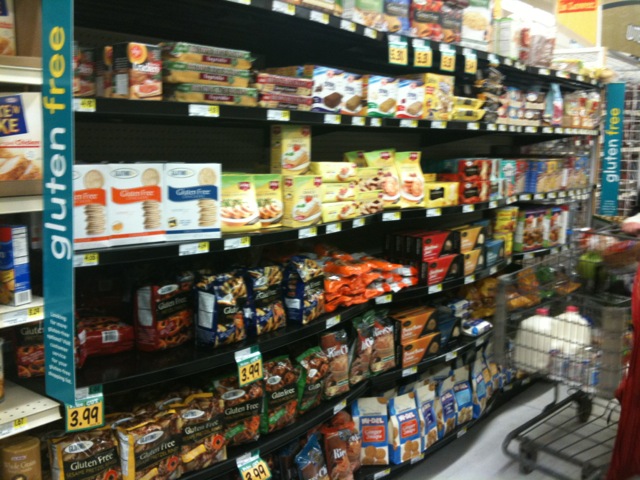
Gluten Free Section at Cub Foods, Blaine, MN

More evidence of the “mainstreaming trend” (according to the the news release) is  “the notable shift in the retail distribution of gluten-free products from specialty stores to chains. The surge in the sales and number of dedicated gluten-free products carried by the supermarkets and mass merchandisers demonstrates that gluten-free is becoming, as one marketer interviewed by Packaged Facts in the report states, ‘just a regular grocery item.’”  I’ll believe that when I see it.  I don’t think that’s nearly the case yet.  But it the shift is true– my local Cub Foods was a prime example when they expanded their gluten-free section and put it in the mainstream section earlier this month.

Do you think it’s on its way  to being as mainstream as other $6 billion dollar industries:  Halloween, potato chips or Yoga?  Feel free to comment below!  My take?  I think we’ll know it’s mainstream when all schools get behind it as a legitimate healthy diet that people should be able to choose and that it’s worth paying for.  Many schools are coming along, but it is very far from being mainstream.

Let’s keep watching over the next few years!

Wednesday, February 2, 2011

Gluten-free has gone mainstream – but how long will that last?

Gluten-free has gone mainstream – but how long will that last?

WENCY LEUNG | From Wednesday's Globe and Mail


In less than five years, sales of gluten-free products have nearly tripled, rising in tandem with the increasing number of new gluten-free goods. Beyond crackers, breads and pastas, it’s now possible to buy everything from gourmet gluten-free cookies at independent bakeries to gluten-free pizzas at restaurant chains such as Boston Pizza.

According to the Rockville, Md.-based research firm Packaged Facts, U.S. retail sales of gluten-free products reached $2.6-billion (U.S.) in 2010, up from $935-million in 2006. And in its 2011 Gluten Free Foods and Beverages report, the firm predicts sales will grow to $5.5-billion by 2015. A similar trend is under way in Canada, although precise national figures are not available. 

Full Article>

More Information>

Friday, September 17, 2010

Gluten-free has gone big time, but why so popular?

09/16/2010 - Michael Hill - Associated Press


This July 5, 2005 file photo shows gluten-free products on
display at a Hannaford Supermarket in Albany, N.Y. U.S.
sales of gluten-free food has more than doubled
since 2005 to over $1.5 billion, according to the market research
company Packaged Facts. And the growth spurt
is expected to continue at least through 2012.
(AP Photo/Jim McKnight, FILE)
Gwyneth Paltrow gushes over gluten-free. Chelsea Clinton's wedding cake was baked without it. The new Old Spice guy avoids the ubiquitous protein to help stay buff. In fact, odds are good you too have tried — or at least encountered — a product with the gluten removed.

Because gluten-free is what low-carb was a decade ago: The "it" diet discussed on daytime talk shows, promoted by hyper-slim actresses and adopted by masses. Grocery aisles are stocked with the likes of gluten-free pasta, crackers, cereal and beer.

Americans are enthusiastically exiling a dietary staple that wasn't even in most people's vocabulary a decade ago.

But why?

Unlike some other dietary boogeymen like trans-fats, gluten is not inherently bad to eat. Only a small percentage of people can't tolerate the protein, which occurs naturally in wheat, barley and rye. Plus, banning gluten from your diet can be really hard.

Not only is gluten an essential element of traditional breads and pastas (it's the protein that gives them their structure), it often is used as a thickening agent in processed foods, such as ketchup and ice cream. And cutting out gluten is no guarantee of weight loss.