Trends in U.S. Military and Correctional Facility Food and Foodservice
This new market study assesses the attitudes toward various on-installation and off-installation foodservice options as well as, analyzes off-site foodservice spending among military service members, military spouses, civilians and retirees.
The report covers food and foodservice operations at military installations, including mess halls, exchanges and recreational facilities; and food and foodservice field training and contingency operations. While it focuses primarily on domestic military food and foodservice, the report also presents global U.S. military foodservice sales and trend analysis.
As a bonus, the report also includes an overview of the U.S. correctional facilities foodservice market, including growth drivers, market sizing and forecasting, prison cost trends, state correctional facility budgeting trends, state prison count reduction strategies, foodservice cost analysis, and foodservice cost cutting initiatives.


Children's Food and Beverage Market in the U.S.
 New Market Research:Children's Food and Beverage Market in the U.S.
These factors and more are influencing the $10 billion market for children’s food and beverages. Take advantage of this market study to:

- Understand the shopping behaviors of your top customers.
- Assess new product introductions as well as, the competitive marketing action plans of key industry players.
- Identify with your client: what motivates kids when it comes to food, beverages and ingredients and flavors.
- Learn the tactics retailers are implementing in marketing to kids.
- Analyze food advertising campaigns geared toward Kids in the 21st Century.
- Evaluate the market composition in seven distinct categories broken down by dollar sales and percent share for strategic perspective and forecasting.
Wednesday, April 13, 2011
Opulent lodgings arise in Boston strictly for pets - The Boston Globe
Opulent digs arise in Hub strictly for the 4-legged set
The Boston Globe | Beth Teitell | 13 Apr 2011

Unlike the kennels of the past, with their chain-link fences and concrete floors, luxury pet hotels offer more than just flat-screen televisions. There are webcams, spas, airy rooms, and, increasingly, cage-free sleeping arrangements that allow pets to sleep on a bed with a hotel employee or engage in slumber parties with other (well behaved) animals.
Learn more about the 2011 - 2012 Pet Market Outlook
View the complete article
Tuesday, March 29, 2011
New Research Study:Trends in U.S. Hospital, Nursing Home and Residential Facility Foodservice
|

What will be the next “big bang” in the U.S. pet market, and what can marketers and retailers do now to help expedite this all-important future sales driver?
|


Wednesday, March 23, 2011
As boomers turn 50 and enter their 60s, they are carrying with them a firm belief that getting older means getting better and they are making health and wellness a top priority.
|

Tuesday, March 15, 2011
QSR Magazine: What Happened to Table Service?
What Happened to Table Service?

The meal deals that spelled survival for sit-down restaurants were like Black Friday to consumers, says David Morris, author of the report Dinner Trends in the U.S. Foodservice Market for Packaged Facts. The upshot was giddy guests (higher guest traffic) with lower guest checks. Great for the consumer, but depressing for operators who are now trying to unwind themselves from the spiral.
[CONT.]
The Cold Standard
One of last year's hottest food and beverage trends came out of the supermarket freezer case, and, given the current economic outlook and consumer shopping habits, industry analysts believe this cold front has moved in for the long stretch.
U.S. retail sales of frozen foods and beverages through all retail channels totaled $55.9 billion in 2010, up 1.7 percent from the previous year, according to Packaged Facts, a division of MarketResearch.com, in its recently released report, "Frozen Foods in the U.S., 3rd Edition" (January 2011). The consumer market research firm, based in Rockville, Md., expects that number to reach $70 billion in 2015.
There's no question that frozen food sales have been driven in part by the economy, which has seen a decline in Americans dining out in favor of eating at home. Frozen foods provide a more affordable alternative to eating out, while at the same time satisfying consumers' eternal craving for convenience. But more recently, manufacturers have introduced a slew of natural, organic and wellness-oriented frozen food and beverage products that has brought attention — and health cred — to the category like never before.
Tuesday, March 8, 2011
Report: Gluten-Free Momentum Accelerating
 |
| Photo Source: MediaPost Publications |
Sales of gluten-free foods and beverages, once considered specialty items, had a compound annual growth rate of 30% in the U.S. between 2006 and 2010, according to the latest report on this category from research publisher Packaged Facts.
Packaged Facts, which previously projected that sales of gluten-free foods and beverages would reach $2.3 billion by 2011, has revised those estimates, putting the market at $2.64 billion in 2010.
Moreover, despite factors such as expected falling product prices due to a greater presence of these items in mass outlets and more private-label choices, the researcher expects gluten-free products to show average annual compound growth of 14% between 2011 and 2015, to reach sales of to $5.6 billion by 2015.
The dynamics behind this growth start with growing consumer awareness of celiac disease -- a chronic autoimmune intestinal disorder in genetically susceptible individuals that causes a toxic reaction to ingesting wheat gluten and similar proteins. A Mayo Clinic study found that the rate of celiac disease has more than quadrupled in the past 50 years -- this despite the fact that it is still "staggeringly under-diagnosed," according to Packaged Facts. Recent estimates are that 1% of Americans, or about 3 million people, may be affected. Food allergies affect about 4% of U.S. adults and 5% of children, and the incidence among children, in particular, has been rising rapidly.
Currently, the only treatment for celiac disease is lifelong adherence to a gluten-free diet -- which is why, these days, "everyone knows someone" who is living gluten-free, one marketer noted to the report's researchers. In addition, there is evidence that gluten-free diets may relieve autism in children and adult rheumatoid arthritis.
Furthermore, from a broader perspective, a growing number of consumers perceive gluten-free products as being of higher quality and having a healthy "aura" -- a dynamic similar to the one that's driven sales growth of kosher foods in recent years, points out the report. "There is a demand for [gluten-free] foods and beverages that mainstream food manufacturers and retailers are increasingly happy to satisfy," observes Don Montuori, publisher of Packaged Facts.
Recognition by major brands and mass retailers of the sustainable -- non-fad -- growth of gluten-free products, and their resulting push to market/carry such products, has resulted in health food stores' share of these products' sales dropping by half in just two years, estimates Packaged Facts. The surge in the sales and number of products specifically marketed as gluten-free in supermarkets and mass merchandisers tracked by Symphony IRI has reached the point that, according to one brand marketer quoted in the report, gluten-free products are becoming "just a regular grocery item."
Dominant gluten-free product categories in food/drug/mass retailers include food/nutrition bars -- which, largely due to General Mills' acquisition of the Lärabar brand in 2008, represent about 16% of total gluten-free product sales in these outlets and showed the largest year-over-year sales growth between 2009 and 2010, according to the report. Sales of gluten-free ready-to-eat cereals declined slightly between 2009 and 2010, but that category remains in second place.
Indeed, General Mills' "transformation" of its popular Rice Chex cereal into a gluten-free product without changing its taste "stands as a milestone indicator of the breadth of impact of gluten-free products having mainstream consciousness," point out Packaged Facts' analysts. As of November 2010, General Mills reported offering 250 gluten-free products, including five varieties of Chex and numerous products under the Betty Crocker and Bisquick brands.
Meanwhile, while product categories such as hot cereal, soups and frozen pizza are still very small segments of the overall gluten-free food/beverage market, they are showing significant, double-digit gains.
Consumers on gluten-free diets are willing to pay the higher prices generally associated with gluten-free products, the report notes.
Friday, February 25, 2011
More Food Service Operators to Use Social Media

The new Social Media and Technology in the U.S. Foodservice Industry: Trends and Opportunities for an Emerging Market report by Packaged Facts explains that everything has changed in the food service industry. Don Monturori, publisher of Packaged Facts says, “We believe the restaurant industry is in the midst of being shaped by the convergence of the mobile, yet always connected, consumer; location-based and context-aware technological innovation, and mobile payments, which already demonstrate the potential to redefine how to cultivate restaurant guest loyalty, incentivize dining occasions, and better tailor marketing messages.” As proof of this new trend, consider these facts:
- Almost 1/3rd (31%) of consumers who frequent restaurants for eat-in or take-out meals use their computers to place orders.
- About 1/5th (21%) of consumers use mobile phones or other devices to place restaurant orders.
As the restaurant industry battles to regain the losses suffered during the recession, most operators will be turning to lower-cost forms of promotions. For many, social media seems to fit the bill.
[Source: Facebook, Twitter and Smartphones Lead Social Media-Fueled Innovation within U.S. Foodservice. PackagedFacts.com. 8 Feb. 2011. Web. 24 Feb. 2011]
More Food Service Operators to Use Social Media - marketingforecast.com
Friday, February 11, 2011
LA Times: Small pet stores see healthy growth of organic food sales
Sales of premium-priced organic and natural pet food are expected to grow three times as fast as pet food sales overall through 2015.

These options are showing up at local pet shops that are looking to distinguish themselves from big-box competitors. After a slowdown in sales of premium-priced food during the recession, independent pet shops said the sector was recovering.
At the Modern Dog, a boutique in a Venice bungalow, co-owner Lance Castro was looking to add two new brands of freeze-dried raw food and premium kibble to the seven he already sells.
"It's done wonders for our business," said Castro, who opened the Abbot Kinney Boulevard store with Guy Miracle five years ago.
The store's popular Sojos dehydrated dog food mix of sweet potatoes, turkey, apples and flax meal, among other ingredients, costs $21.99 for a 2-pound bag, to which water is added to make 10 pounds of food.
Castro said he was looking at sites for a second location where he plans to have a refrigeration unit for fresh and frozen raw-food brands.
Nationwide, annual retail sales of organic and natural pet food are expected to grow three times as fast as pet food sales overall through 2015, according to an industry report to be released this week by the Packaged Facts market research company.
Industry analyst David Lummis, who wrote the report, estimated that natural and organics would grow 12% a year on average, hitting $2.8 billion in 2015. By comparison, he expects an average 4% annual growth rate for the entire pet food market over the same period. Overall pet food sales will reach $22.1 billion in 2015, Lummis said.
"People are treating their dog food like some people are treating their baby food," said Todd Martin, vice president of marketing for Castor & Pollux Pet Works, a Clackamas, Ore., company that makes organic pet food and treats. "They want to know it's safe, and they want to know it's quality."
Still, organic pet food — which costs as much as 30% more than non-organic — remains a tiny part of the overall market.
Many independent shops, which are in the vanguard of the organic food sector, got a boost in business in 2007 when pets died from eating food that contained imported wheat gluten and rice protein contaminated with melamine. The poisonous contaminant even showed up in some brands sold as being natural.
As with food for people, there are no regulations governing the word "natural" on pet food labels. But pet foods marketed as organic must meet the same U.S. Department of Agriculture standards as human food in the category, according to USDA spokesperson Soo Kim.
Annual sales of organic pet food increased tenfold from 2002 to 2009, when sales hit $84 million, according to the Organic Trade Assn.
Now that organics are becoming more popular, some large pet store chains are also carrying them, said Joan Storms, an analyst at Wedbush Securities in Los Angeles.
But the more exotic raw and organic pet food is still mostly the province of independent shops.
Neal Massa is co-owner of My Pet Naturally in West Los Angeles, where customers can find raw elk meat for $7.49 a pound and raw chicken and lamb for Fido for about $4 a pound.
"My clientele are probably mostly single, more single women than not, and what I am finding is that these are their kids," Massa said, referring to his customers' pets. "So you are going to spend a little bit more money for pet food."
Full Article: Pet food: Independent pet stores see growing sales of organic and natural pet food - latimes.com
Tuesday, February 8, 2011
From pushcart to grocery cart
The playbook for U.S. foodmakers often calls for exporting a successful U.S. product to points abroad. General Mills, for instance, has had a big hit in China with its classic Bugles corn snacks, albeit in some flavors we might not find here -- like seaweed.
 |
With its Wanchai Ferry brand, the Golden Valley-based packaged food company has called a reverse. The brainchild of a Hong Kong pushcart vendor, Wanchai Ferry evolved into a popular supermarket brand in China.
General Mills brought the brand to the United States, and so far, it's done well. Since the 2009 launch of Wanchai Ferry frozen dinner entrees for two, they've generated more than $50 million in annual sales and quickly grabbed a respectable slice of market share.
Multi-serving dinners are a sweet spot in the frozen meal business, but one that's also attracting a lot of competition. Within a year of Wanchai Ferry's debut, packaged food giant Unilever teamed up with restaurant chain P.F Chang's China Bistro to launch a frozen entree sporting the latter's brand. Its sales appear to have jumped ahead of Wanchai Ferry's.
Wanchai Ferry is rooted in the business of Chong Kin Wo, or Madame Chong. In the 1970s, she started selling dumplings in Hong Kong's busy Wanchai commercial area, and her wares eventually made it into grocery stores under the Wanchai Ferry brand. Pillsbury bought the brand in 1997, and General Mills inherited it with its purchase of Pillsbury in 2001.
General Mills has built the brand into one of its star assets in China. Wanchai Ferry products, including dim sum and wontons, are available in about 100 Chinese cities, carried by such major international food retailers as Wal-Mart and France's Carrefour. Wanchai Ferry sales in China in 2010 were up 20 percent over the previous year.
In 2007, General Mills launched Wanchai Ferry dry dinner kits in the United States, which require consumers to add meat and cost about $4.60. In 2009 came the debut of frozen entrees, complete with meat, which can be prepared in about 15 minutes and cost $7 to $8.
While the brand name is the same as in China, the products are different, an attempt to account for American tastes, Nudi said. The frozen dinners come in eight varieties, including Orange Chicken, Shrimp Lo-Mein and Beef & Broccoli. The goal is to deliver "restaurant quality food," Nudi said.
Multi-serve dinners like Wanchai Ferry have been a bright spot in the frozen entree world, despite their relative high cost during a tough economy. They've been the only frozen meal segment posting sales gains since 2008 among food mass merchandisers excluding Wal-Mart, according to a fall report by market researcher Mintel International.
"Given that its biggest increases were during the peak of the recession, it appears that this segment has done a better job than the others in capturing dollars that might have otherwise been spent dining out," the Mintel report said.
According to market researcher SymphonyIRI Group, which tracks sales in conventional supermarket channels, Wanchai Ferry carved out about a 3 percent share of both the multi-serve frozen meal business and the dry dinner mix segment by the end of last year.
The dry dinner market is dominated by General Mills' Hamburger Helper. The frozen, multi-serve meal segment is topped by Stouffer's and Bertolli, with market shares respectively of 31 percent and 10 percent, according to IRI. P.F. Chang's had captured 5 percent of the market by the end of December, according to SymphonyIRI.
Restaurant brands have long enjoyed success when transplanted to the frozen food aisles. Stouffer's itself was born from a now-defunct restaurant chain, while the Marie Callender's brand originated from a western restaurant group, according to a recent report by market researcher Packaged Facts.
General Mills got into the restaurant act itself last year by launching multi-serve frozen dinners in a partnership with Romano's Macaroni Grill. That gives General Mills a two-front offensive in the freezer: Macaroni Grill for Italian tastes, Wanchai Ferry for Asian.
Mike Hughlett • 612-673-7003
Friday, February 4, 2011
Gluten Free Gone Mainstream?
Going “mainstream” for gluten free foods may have a different meaning for everyone. For restaurants, it may just mean putting together a gluten free menu (regardless of education), for grocery stores it may mean putting it in the main aisles (and the employees know what you’re talking about if you ask them a question), but for me it’s all of the above and more — including a good basic public awareness on what it really means.
That could be the case if new product survey which looks ahead a few years is accurate. According to a news release for “Gluten-Free Foods and Beverages in the U.S., 3rd Edition” by market research publisher Packaged Facts, the gluten-free market is currently a $2.6 billion dollar industry. It reports it will likely double to about $6 billion by 2015! $6 billion is similar to the current industries of Yoga, Halloween, and Potato Chips! What’s more mainstream than Halloween and potato chips (well maybe not together). But even if you look at Yoga, I think one might consider that when it started as a fitness regime in the US, it wasn’t considered mainstream and look where it is today!
Could gluten-free food be the next Yoga?Well, that answer remains to be seen– but the survey showed, “The #1 motivation for buying gluten-free food products is that they are deemed healthier than their conventional counterparts.” Don Montuori, publisher of Packaged Facts is quoted in the release, “…there is evidence suggested that eliminating gluten from the diet may relieve autism in children and adult rheumatoid arthritis. Add to that the healthy ‘aura’ some consumers have attached to gluten-free products, and you create a demand for these foods and beverages that mainstream food manufacturers and retailers are increasingly happy to satisfy.”
People are buying gluten-free to treat celiac, autism or some other ailment but also as a healthy kick to their diet. I do think the healthy gluten-free “fad” has benefited those in the celiac world– not so much with education regarding a correct gluten-free diet, but rather in selection for foods for us.
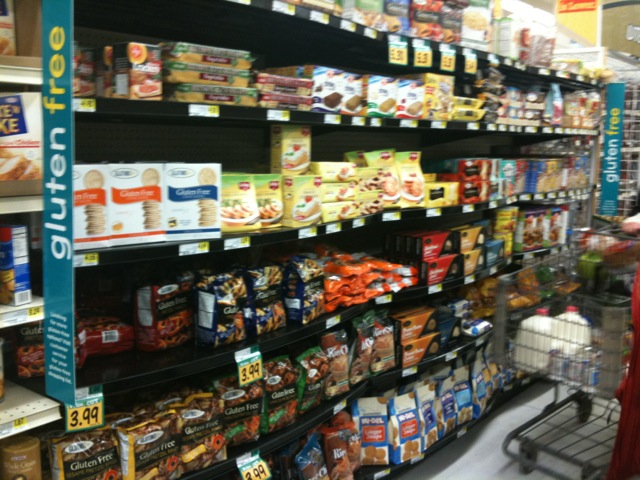 |
| Gluten Free Section at Cub Foods, Blaine, MN |
Do you think it’s on its way to being as mainstream as other $6 billion dollar industries: Halloween, potato chips or Yoga? Feel free to comment below! My take? I think we’ll know it’s mainstream when all schools get behind it as a legitimate healthy diet that people should be able to choose and that it’s worth paying for. Many schools are coming along, but it is very far from being mainstream.
Let’s keep watching over the next few years!
Thursday, February 3, 2011
High Quality Prepared Food Departments Add Dine-in Cafes to Drive Traffic at Grocery Stores
 |
| Prepared food bar at Wegmans. Photo Courtesy of toujourspretamanger.com |

Wednesday, February 2, 2011
Gluten-free has gone mainstream – but how long will that last?

Gluten-free has gone mainstream – but how long will that last?
WENCY LEUNG | From Wednesday's Globe and Mail
Published
In less than five years, sales of gluten-free products have nearly tripled, rising in tandem with the increasing number of new gluten-free goods. Beyond crackers, breads and pastas, it’s now possible to buy everything from gourmet gluten-free cookies at independent bakeries to gluten-free pizzas at restaurant chains such as Boston Pizza.
According to the Rockville, Md.-based research firm Packaged Facts, U.S. retail sales of gluten-free products reached $2.6-billion (U.S.) in 2010, up from $935-million in 2006. And in its 2011 Gluten Free Foods and Beverages report, the firm predicts sales will grow to $5.5-billion by 2015. A similar trend is under way in Canada, although precise national figures are not available.
Full Article>
More Information>
Tuesday, February 1, 2011
The Future of Food Retailing in the U.S.
|

Monday, January 24, 2011
Download White Paper: 2011 Consumer Insights and Trends: Packaged Facts Forecasts the Product and Social Trends That Will Make Their Mark in 2011
The ball dropping in Times Square, resolutions, diets . . . all these are familiar signifiers of a new year. So, too, are prediction lists: what’s going to be hot, what’s not.
We at Packaged Facts have some experience gazing into a crystal ball and divining trends for the consumer marketplace (publishing market research studies on consumer goods and services for more than 50 years can come in handy . . .).
This month we gathered our market experts and asked them for their predictions regarding the product and social trends that will make their mark in 2011. Download our free whitepaper to hear Packaged Facts' analysts insights and predictions on:

* Retailing Trends
* Pet Market
* Apparel Industry
* Consumer Hobbies
* Personal Care Products
* The Use of Social Media
* Food and Beverage Market
* Baby Boomer Attitude and Behavior Shifts
Download:
http://www.packagedfacts.com/catalog/search.asp?query=white+paper
Friday, January 14, 2011
Study: Modest Growth in Pet Supplement Sector
Study: Modest Growth in Pet Supplement Sector
 Growth
of pet supplement and nutraceutical treat sales in the U.S. stalled in
2010, but the category is expected to gradually pick back up in the next
five years, according to a report released today by market research
publisher Packaged Facts.
Growth
of pet supplement and nutraceutical treat sales in the U.S. stalled in
2010, but the category is expected to gradually pick back up in the next
five years, according to a report released today by market research
publisher Packaged Facts.“As the economy improves, so should all things pet, but that recovery continues to appear modest,” said David Lummis, senior pet market analyst for Packaged Facts. “Spending on supplements will increase, but restraint will likely continue to characterize how pet owners shop and what they buy during 2011 and even 2012, making value appeals based on pet health, safety, professionalism, practicality, and yes, pricing, more important than ever.”
From 2006 to 2010, sales of pet supplements and nutraceutical treats grew at a compound annual growth rate of about 4 percent, to reach $1.2 billion in 2010, according to the report.
Following zero overall growth in 2010, Packaged Facts forecasts U.S. retail sales of pet supplements and nutraceutical treats to begin to pick back up in 2011, with the annual sales gains regaining steam through 2015. By this account, the annual percentage increases will rise from 2.4 percent in 2011 to 6.5 percent in 2015, lifting sales to approximately $1.6 billion in 2015, according to the report.
Packaged Facts anticipates growth to be considerably faster on the small animal side, which includes dogs, cats, birds, small mammals and herps, than on the equine side, with the compound annual growth rates coming in at 7.4 percent and 2.2 percent, respectively. As a result, small animal is expected to account for 58 percent of the market by 2015, up from 52 percent in 2010.