Search This Blog

Showing posts with label marketers. Show all posts

Wednesday, March 23, 2011

As boomers turn 50 and enter their 60s, they are carrying with them a firm belief that getting older means getting better and they are making health and wellness a top priority.

Healthy 50+ Americans: Trends and Opportunities in the Emerging Wellness Market

New Research Study: Healthy 50+ Americans: Trends and Opportunities in the Emerging Wellness Market

As boomers turn 50 and enter their 60s, they are carrying with them a firm belief that getting older means getting better and they are making health and wellness a top priority.

Today, large food companies are exercising strategic focus on boomers by introducing foods that enhance their health and vitality. Beverage companies are following suit with new juice and dairy- and yogurt-type drinks that enhance immune function.

Why such focus on this cohort? Besides the growing population size and large bank accounts, Packaged Facts' exclusive survey data reveals that healthy consumers 50+ are far more likely to reach into their wallets to pay extra for "better-for you" grocery products when compared to their peers in the same age group.

Food and beverage marketers will benefit from the analyzes and insight inside this brand-new research study. In addition to taking advantage of the latest trends and opportunities in the emerging wellness market you will:

  • Uncover the eating habits and attitudes of healthy 50+ Americans toward calorie counts, food and beverage choices, and managing nutrition.

  • Learn what this cohort is doing to stay healthy, hint: they prefer alternative and homeopathic medicine.

  • Craft business plans with our buying power forecast through 2015.

  • Understand the healthy 50+ American with our detailed analysis including education, finances, core values and leisure and entertainment choices.

  • Discover how this demographic will have the biggest impact on your bottom line in the five years ahead.

More information:
Price/Info   |   Table of Contents   |   Place an Order

Friday, February 4, 2011

Gluten Free Gone Mainstream?

Source: http://thesavvyceliac.com/2011/02/02/gluten-free-gone-mainstream/

Going “mainstream” for gluten free foods may have a different meaning for everyone.  For restaurants, it may just mean putting together a  gluten free menu (regardless of education), for grocery stores it may mean putting it in the main aisles (and the employees know what you’re talking about if you ask them a question), but for me it’s all of the above and more — including a good basic public awareness on what it really means.

That could be the case if new product survey which looks ahead a few years is accurate. According to a news release for “Gluten-Free Foods and Beverages in the U.S., 3rd Edition” by market research publisher Packaged Facts, the gluten-free market is currently a $2.6 billion dollar industry.  It reports it will likely double to about $6 billion by 2015!  $6 billion is similar to the current industries of  Yoga, Halloween, and Potato Chips!  What’s more mainstream than Halloween and potato chips (well maybe not together).  But even if you look at Yoga, I think one might consider that when it started as a fitness regime in the US, it wasn’t considered mainstream and look where it is today!
Could gluten-free food be the next Yoga?
Well, that answer remains to be seen– but the survey showed, “The #1 motivation for buying gluten-free food products is that they are deemed healthier than their conventional counterparts.”  Don Montuori, publisher of Packaged Facts is quoted in the release, “…there is evidence suggested that eliminating gluten from the diet may relieve autism in children and adult rheumatoid arthritis. Add to that the healthy ‘aura’ some consumers have attached to gluten-free products, and you create a demand for these foods and beverages that mainstream food manufacturers and retailers are increasingly happy to satisfy.”
People are buying gluten-free to treat celiac, autism or some other ailment but also as a healthy kick to their diet.  I do think the healthy gluten-free “fad”  has benefited those in the celiac world– not so much with education regarding a correct gluten-free diet, but rather in selection for foods for us.
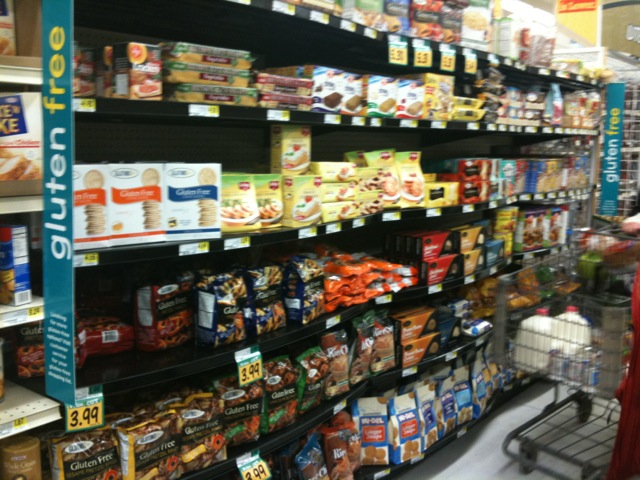
Gluten Free Section at Cub Foods, Blaine, MN

More evidence of the “mainstreaming trend” (according to the the news release) is  “the notable shift in the retail distribution of gluten-free products from specialty stores to chains. The surge in the sales and number of dedicated gluten-free products carried by the supermarkets and mass merchandisers demonstrates that gluten-free is becoming, as one marketer interviewed by Packaged Facts in the report states, ‘just a regular grocery item.’”  I’ll believe that when I see it.  I don’t think that’s nearly the case yet.  But it the shift is true– my local Cub Foods was a prime example when they expanded their gluten-free section and put it in the mainstream section earlier this month.

Do you think it’s on its way  to being as mainstream as other $6 billion dollar industries:  Halloween, potato chips or Yoga?  Feel free to comment below!  My take?  I think we’ll know it’s mainstream when all schools get behind it as a legitimate healthy diet that people should be able to choose and that it’s worth paying for.  Many schools are coming along, but it is very far from being mainstream.

Let’s keep watching over the next few years!

Tuesday, February 1, 2011

The Future of Food Retailing in the U.S.

The Future of Food Retailing in the U.S.

The Future of Food Retailing in the U.S.

Growing competition, emerging retail formats, price wars, more private labels, SKU rationalization, and experiments with online marketing are trends reshaping the food retailing market.
Packaged Facts' latest market study, The Future of Food Retailing provides insightful macro and micro trend analyses for retailers and CPG marketers who seek merchandise, pricing, and marketing strategies for today's food retailing environment.
This market study answers the following questions:
  • How has the new economic climate changed consumer behavior?
  • Can smartphone apps, such as in-store navigation, drive more business?
  • Will recent mergers and acquisitions impact your bottom line?
  • How are personalized and digital coupons be leveraged to maximize profit?
  • Why is sustainability equal to profitability this year?
  • How are C-stores changing with the times?
  • How is Koger changing how consumer data is mined?
  • Why are food retailers morphing into foodservice and how does that translate to dollars?
Packaged Facts identifies the opportunities and strategies retailers and CPG marketers can use to protect and grow their businesses during 2011 and beyond.
More information:
Price/Info   |   Table of Contents   |   Place an Order

Sunday, January 2, 2011

A sweet finish to the year

A sweet finish to the year

Christmas is a lucrative time for local chocolatiers as they continue to weather the economy's downturn.
Last update: December 23, 2010 - 10:08 PM

The machines were humming this week inside the sprawling factory at Abdallah Candies in Burnsville. A worker gently sprinkled sea salt onto dark chocolate pieces as they moved along a conveyor belt, while two women on a nearby line stamped "B's" into the warm chocolate that enveloped a vanilla-butter-cream filling.
"They're going out the door as fast as we can make them," said CEO and owner Steven Hegedus, the fourth generation to run the company, as he surveyed the 65,000-square- foot plant. "Business is brisk."
Christmas makes up 35 to 40 percent of annual sales at Abdallah, which manufactures chocolate candies and confections for more than 6,000 gift and specialty food stores across the country, as well as Lunds and Byerly's locally. The company specializes in "everyday chocolate," generally priced lower than most handmade artisan brands, but higher than, say, Hershey's.
If America's sweet tooth provides insight into how consumers feel about the economy, chocolatiers such as Hegedus have some hope for the year ahead.
"We put resources into infrastructure so that when the economy picked up, we'd be poised to be at the next level of production," he said. "That's exactly what's happening now. The recession's not over, but it's picking up."
The $17.3 billion U.S. chocolate industry has expanded, but hasn't regained its prerecession pace of growth, according to consumer market research firm, Packaged Facts. Sales have been resilient mainly because the percentage of Americans who buy chocolate -- 3 out of 4 -- has remained steady.
Industry experts attribute that relative vigor to what economists call the "lipstick factor," where sales of small luxury items stay strong during times of economic hardship because of their ability to lift spirits.
Nonetheless, the recession has forced a handful of chocolate makers in the Twin Cities to become more nimble, and to think of their business in new ways.
Brian McElrath and Christine Walthour, a husband-and-wife team who own wholesaler B.T. McElrath, have completed shifted their business model. A couple of years ago, they manufactured mostly filled chocolates. But in 2009 they boosted production of high-quality chocolate bars.

Friday, November 12, 2010

New Research: Dinner Trends in the U.S. Foodservice Market


Packaged Facts estimates that dinner daypart restaurant sales dropped 5% to $174 billion in 2009, and is forecasted to drop another 3% in 2010. But all is not lost, Packaged Facts research indicates a spending renaissance is already underway.

http://www.packagedfacts.com/docs/PF_Foodservice_Landscape_2010_Sample_Pages.pdfBy combining investment-grade industry analysis with key trend analysis, Dinner Trends in the U.S. Foodservice Market not only helps foodservice industry participants address challenges unique to the dinner daypart but also helps participants contour their strategies to meet consumers’ evolving needs.

By providing insight on the dinnergoer’s decision-making process, this report provides direction on how and why the consumer decides on a specific restaurant from which to obtain dinner, and how and why that consumer decides what to order from the menu.

Selection factors are analyzed according to the following categories:

  • convenience;
  • dinner menu items;
  • meal cost thresholds;
  • dine-in and takeout partner;
  • menu positioning and advertising;
  • health positioning;
  • and bundled offers.

More Information>>

Research Features:

  • “Share of stomach” restaurant dinner sales analysis, which includes 5-year sales trends for the fast food/quick-service restaurant and full-service restaurant segments, with forecasts for 2010 and 2011.

  • Guest traffic frequency analysis of leading dinner-centric restaurant brands, giving a directional perspective on current sales trends.

  • Trended analysis of demographic dinner daypart expenditures, including 4-year sales historical sales trends and spending according to key demographics, such as age, income, region, and race/ethnicity.

  • Thorough psychographic analysis of Budgeters, Alcohol Indulgers and Healthy Eaters, key psychographic groups shaping the dinner daypart.

The report also conducts trend analysis on key dinner-centric restaurant brands, including menu strategies and new menu item introductions, core users; snacking tendencies; food, diet and health attitudes; as well as trends sales metrics. We focus on recession-driven responses and menu strategies taking the brands into 2011.

Coverage extends to fast food/QSR, coffeehouse, smoothie shop, ice cream shop, family restaurant, casual restaurant, and fine dining restaurant segments; as well as prepared foods segments at convenience stores/gas stations and grocery stores/supermarkets.

More Information>>


Dinner Trends in the U.S. Foodservice Market is part of Packaged Facts' new Foodservice Market Insights collection. Additional titles include:

The insights you need, all in one collective series from Packaged Facts. Download our Foodservice Market Insights brochure and get the full details on data methodology, foodservice consumer perspective and analysis, and more.

http://www.packagedfacts.com/docs/foodservicebrochure_082010_WEB.pdf


View the brochure

http://www.packagedfacts.com/docs/PF_Foodservice_Landscape_2010_Sample_Pages.pdf

See sample pages

Wednesday, October 20, 2010

ITP Furnishings/Accessories/Toys Marketplace Transformed by Recession

Packaged Facts observes that the consumer ITP durables marketplace has morphed under the pressure of the difficult U.S. (and world) economies, since at least 2007.  Although retail dollar growth was still positive in that year across all three of our ITP categories studied here – furnishings, essentially homebound; accessories, more portable; and toys of an astonishing range of types – changes were already in effect:  Pre-recession, many marketers were entering new brands, or extending their established brands, into the lower reaches of the luxury price-tiers, and more obviously, into middle luxury – “mid-luxe” tiers. 

In the stroller segment of the accessories category, for example, marketers such as Newell Rubbermaid, having bought the sophisticated Japanese-made Aprica brand earlier in 2008, thus covered the under $200-$370 range more deeply, because the new acquisition complemented Newell’s popular Graco brand, priced up to $270.  Also pre-recession, Phil&teds and UPPAbaby were both rolling out namesake brands with high-tech or elegant design features, at MSRPs topping out at the upper reaches of the mid-luxe tier, or at $600-$700. 

Initially, these marketers may have viewed their price-positionings as shrewd competitive moves versus the $1,000-plus Bugaboos, Maclarens, Stokkes, and other strollers.  Bugaboo, not content to be the mid-luxe specialists’ punching bag, introduced the Bugaboo Bee in 2007, listing it at $535.

There was also some accommodation of the value set, with extensions downward into the under-$200, and even under-$100, brackets; the low-end models were often lightweight umbrella strollers, but in any case, tended to show the design influences of higher-priced counterparts. 

As the cost of fossil fuels skyrocketed, and consequently, the pricetags on groceries and manufactured goods also shot up; as the U.S. mortgage scandal unfolded; as unemployment rates rose; as the war in Iraq cost untold billions – some ITP durables marketers may have concocted their multi-price-tiered battle plans to double as hedges against a recession that did happen, after the fourth quarter 2008 crashes of financial exchanges around the globe. 

In 2010, there is plenty of anecdotal evidence that high-end ITP durables -- for instance, the Teutonia brand of German-made strollers acquired by Newell Rubbermaid in 2007, and now priced up to $890 -- are selling well again.  But the newly reinforced mid-luxe and value tiers will be with us for a long time to come, offering wider arrays of brands, and certainly, more choices of affordable status brands.

Thursday, September 23, 2010

Ice Cream and Frozen Desserts in the U.S.: Markets and Opportunities in Retail and Foodservice, 6th Edition

The U.S. market for ice cream and related frozen desserts neared $25 billion in 2009, with sales growth from previous years slowed somewhat by the recessionary economy. Manufacturers of retail frozen desserts and operators in the frozen dessert foodservice industry (which accounts for better than half of total category sales) adjusted their prices in order (or held the price line and reduced package sizes) to keep consumers screaming for ice cream instead of about how much it cost. Price controls and price-based promotions are likely to stay in effect as the economy slowly rebounds. So, too are cost-saving trends like the consolidation of companies and brands, as in the case of Hood and Brighams, and industry production and administrative facilities, as practiced most notably by Unilever.

But, as the Packaged Facts report on ice cream and other frozen desserts - including ice cream, frozen yogurt, gelato, frozen custard, water ices, non-dairy frozen desserts and frozen novelties - notes, keeping prices down will not be enough to expand sales. To do that, manufacturers and foodservice operators alike will be looking to build on the trends that have emerged over the past two years, notably a taste for tart frozen yogurt that features good-for-you probiotic bacteria that improve digestion. The Packaged Facts report suggests the likelihood of probiotics being added to other frozen desserts and includes coverage of other healthy ingredients that may soon be showing up in value-added health-oriented frozen dessert products such as prebiotics (that make probiotics more efficient), Omega-3, and...

More Information>>

Wednesday, September 22, 2010

Consumer Payment Trends in the U.S.

Photo courtesy of OnlythePearl.com
Businesses routinely seek to appeal to consumers by understanding which goods or services they want to buy. But understanding how shoppers prefer to buy—that is, which forms of payments they favor, and why—is also critically important. Marketers, retailers, card associations and other product and service providers hope to make transactions easy and convenient for consumers, but they must also balance these requirements against their own needs. Meanwhile, in the post-recession U.S. marketplace the world of payments keeps evolving as consumers back away from credit cards, debit cards move toward saturation, online payment options proliferate, and contactless payments and mobile payments move closer on the horizon.

This all-new report from Packaged Facts examines consumer payment forms of all kinds, including credit cards, debit cards, gift/prepaid cards, cash, checks, online payment and emerging forms, with a focus on how consumer preferences have changed during the past five years and vis-à-vis the economic downturn and recovery. It includes:

  • Analysis of how Americans’ financial outlook influences their spending and payment preferences.
  • Demographic and psychographic profiling by payment form and consumer age, gender, race, geographic region, income, educational level, etc.
  • Focus chapter on cash, whose straightforwardness and immediacy makes it the payment choice of more than half of U.S. adults.
  • Focus chapter on checks, which despite declining usage remain popular for bill paying and are getting new legs via “digital reinvention.”
  • Focus chapter on credit cards, which have reached saturation and face other challenges including more restrictive legislation and declining usage among consumers looking to reduce their debt.
  • Focus chapter on debit cards, which continue to win followers but whose rise may be diverted by laws restricting overdraft fees.
  • Coverage of gift cards and other prepaid debit cards, which are creating a fast-growing “second-tier” banking system for those without access to traditional banks.
  • Focus chapter on new payment methods, including contactless, cell phone and Internet-based, all of which are jockeying for position in the next wave of payment forms.
More Information>>

Monday, September 20, 2010

Millenials in the U.S.: Trends and Opportunities Surrounding Gen-Y Adults

The 51 million adult members of the Millennial Generation (also known as Gen-Y) have been hit harder than any other age group by the recession. Millennials have the highest unemployment rate of all age groups, while those with jobs are most likely to have been asked at some point during the recession to work fewer hours, switch to part-time employment or agree to have their pay cut.
brandchannel.com
Yet, paradoxically, survey data show that Millennials are less likely than any other age segment to have cut spending during the recession, and they are more optimistic than other American consumers about the future of the American economy.

More>

Saturday, September 18, 2010

Cheese: Natural and Specialty Cheeses in the U.S. and Global Markets

With U.S. production of natural and specialty blended (N&SB) cheese at an all-time high — 10 billion-plus pounds by the end of 2009 — marketers are aggressively creating points of differentiation to better establish their brands in this highly competitive and crowded category. With more than 300 varieties of natural cheese made in the States, as well as just as many specialty blended cheeses, this is no easy feat, particularly when there are more than 200 marketers vying for the attention of consumers, retailers, chefs and even prepared foods product developers.

More Information>>

Friday, September 17, 2010

Coffee and Ready-to-Drink Coffee in the U.S.: The Market and Opportunities in Retail and Foodservice, 6th Edition

McDonald's McCafe
As the U.S. economy slid deeper into recession during 2009, coffee marketers and foodservice operators moved in the opposite direction, digging out of the trench of 2008 with a variety of strategies designed to capitalize on the fact that even upscale coffee is a relatively thrifty luxury that offers comfort during stressful times. Two success stories were the rebound of Starbucks on the foodservice side and the revitalization of the former P&G retail coffee portfolio by J M. Smucker. Although the era when the coffee market grew effortlessly through premiumization may have ended, such upscale trends as the shifts towards specialty coffee beverages, gourmet beans and ethical consumerism are still clearly in force. What’s more, there’s ample opportunity for companies to capitalize on such trends as the economy recovers—not by ignoring the tougher times or reversing strategy, but by crafting an image that’s both upscale and responsive to consumers’ stronger-than-ever demand for value.

Packaged Facts’ Coffee and Ready-to-Drink Coffee in the U.S.: The Market and Opportunities in Retail and Foodservice, 6th Edition offers a comprehensive look at this $47.5 billion market, examining both the retail and foodservice sides of the business as well as the growing overlap of the two. On the retail...

More Information>>

Friday, September 3, 2010

Consumer Interest in Health, Convenience and Localism Fuel $16 Billion U.S. Market for Fresh Baked Goods

Consumer interest in healthy eating, artisan foods and 'localism' countered recessionary pressures and helped fuel the fresh baked goods market to grow 4% in 2009 to reach $16 billion, according to Fresh Baked Goods in the U.S. by market research publisher Packaged Facts.

Total fresh baked goods sales experienced slow but steady growth in the 2%-4% range throughout the 2005-2009 period, with the exception of 2008 when the market saw almost 6% growth. Fresh baked goods sales from in-store bakeries including those of warehouse clubs also experienced steady growth, in the 2%-5% range, reaching $11 billion in 2010 and comprising nearly three-quarters of the total retail market.

Packaged Facts projects that the market for fresh bakes goods will exceed $20 billion by 2014.

Packaged Facts divides the fresh baked goods market into two major product classifications: sweet baked goods and breads. The sweet baked goods classification encompasses cakes, cupcakes, cookies, pies, brownies and other baked dessert products. The breads classification encompasses bread (including sliced and unsliced loaves), rolls, pitas and croissants. This report also discusses breakfast baked goods (which overlap both classifications), including doughnuts, muffins, breakfast breads, bagels/bialys and sweet rolls.

"Although fresh baked goods are produced and sold in a wide variety of retail channels, certain overriding trends have affected how these products are marketed across most channels," says Don Montuori, publisher of Packaged Facts. "For example, consumer demand for specific kinds of products such as those that fill specific dietary needs or budgetary concerns has led retailers to adapt in terms of both product offerings and marketing strategies. In the fresh baked goods market, those bakeries that have managed to succeed in this challenging environment have done so by evaluating and quickly responding to these shifts in consumer demand with products that fulfill a variety of consumer needs and wants."

A new report from Packaged Facts, Fresh Baked Goods in the U.S. offers a comprehensive look at the overriding trends in the market. The report examines baked goods that are prepared fresh at both in-store and stand-alone bakeries, using preparation methods such as made-from-scratch, mixes, par-baking (or pre-baking) and thaw-and-heat. It also analyzes trends in the key retail channels through which baked goods are sold) both stand-alone bakeries and in-store outlets (including traditional supermarkets, supercenters/mass merchandisers, natural food stores, and warehouse clubs. Additionally, the report examines activity at the foodservice level, where trends in baked goods often start, focusing on high-growth areas including bakery cafes.

More>>

Wednesday, September 1, 2010

Gay and Lesbian Consumers Gateway to Post-recession Business Success

The expanding gay and lesbian population is providing marketers the opportunity to pick up some post-recession business, a new market research study from Packaged Facts says. The study, titled The Gay and Lesbian Market in the U.S., shows that today's 15.7 million gay and lesbian consumers are more optimistic than other consumers about the overall direction of the country, future economic growth, the job market and their own personal financial condition. This basic sense of optimism prevailing among gay and lesbian consumers suggests that they are more willing than other consumers to spend on products and services in the wake of the most severe economic downturn in 70 years.


The report currently estimates the purchasing power of gay and lesbian consumers at $743 billion but is expecting this market to grow 23% to $900 billion as the population grows to 16.4 million in 2014.Retailers in major metropolitan areas, such as New York, will see much of this good fortune due to higher number of gays and lesbians living in the area. For example, New York currently ranks first among the top fifteen gay and lesbian metro areas and claims $52 billion of this cohort's disposable income.

Metropolitan or otherwise, marketers will be interested to know that when deciding whether to stick or switch from a product or service, gay and lesbian consumers are highly alert to the perceived gay-friendliness of companies. Survey data from the report shows 32% gay men and 25% of lesbians have switched products or service providers because they found a competing company that supports causes that benefit the LGBT community. Furthermore, nearly 60% in this cohort report being 'more likely' to purchase everyday household products and services from companies that market directly to gays and lesbians.

More>>

Tuesday, August 31, 2010

Private Label Food and Beverages in the U.S.

At one time, private-label products accounted for a small share of the overall food and beverage market. But today, many retailers are claiming penetration rates of 25% or more of total sales.


Private Label Food & Beverage in The U.S. analyzes the U.S. market for foods and beverages sold under the proprietary labels of retailers, referred to in the trade as private-label or store-brand products.

The primary focus is on the mass-market products sold through supermarkets, big box, warehouse clubs, and mass merchandisers, but the report also examines trends affecting other food and beverage retailers, including convenience stores, drugstores, health and natural food stores. Included are estimates of total dollar sales, unit sales and average prices per unit for the 2005-2009 period along with forecasts for growth through 2014.


Competitor profiles include:
  • Aldi
  • Costco
  • Delhaize
  • Kroger
  • Safeway
  • Target
  • Trader Joe's
  • Wal-Mart
  • Whole Foods

More>>

Monday, August 30, 2010


Demographic Trends

As the economy slowly recovers from the recession depths of 2008 and 2009, marketers and market researchers differed sharply over whether the price-conscious consumer who dominated the marketplace during the Great Recession would prove to be a temporary aberration or a permanent fixture in the American economy.
New Research:The Gay and Lesbian Market in the U.S.: Trends and Opportunities in the LGBT Community, 6th Edition
Report CoverThe expansion of same-sex marriage and other forms of civil unions over the past decade is triggering an increase in the visible numbers of gay and lesbian family households and consequently an expanding market space for consumer goods and services of all kinds.
Survey research shows that gay and lesbian consumers are more optimistic than other consumers about the economy and personal finances, indicating that gay and lesbian consumers are more likely to amp up discretionary spending on products and services in the wake of the recession.
This completely new 6th edition of Packaged Facts Gay and Lesbian Market in the U.S. provides marketers with the analysis and insights they need to help them succeed in a consumer segment whose buying power is fast approaching $800 billion.
More Information:
Info   |   Table of Contents

 The Post-Recession Consumer in the U.S.
Report CoverThis Packaged Facts report sifts through five years of data to follow the twists and turns in consumer confidence before, during and in the immediate aftermath of the most severe economic downturn in 70 years.
The report contrasts the attitudes and behavior of consumers on the highest end of the Consumer Confidence Index of the Experian Simmons NCS (“Confident Consumers”) with those on the lowest end (“Anxious Consumers”). By doing so, it sheds light on the conflicted mindset of consumers as the recession loses its grip and suggests how marketers might respond to their customers in an uncertain post-recession economic environment.
The Post-Recession Consumer in the U.S. provides in-depth insights into trends affecting the post-recession environment in key areas such as price sensitivity and use of premium brands and highlights key opportunities in the post-recession consumer market. Subsequent chapters offer an in-depth view of how Confident and Anxious Consumers shop in supermarkets and drugstores and how they behave when shopping for the home also included is data on how they spend leisure time and their behavior in the fashion and automotive sectors.
More information:
Info   |   Table of Contents

The African-American Market in the U.S., 8th Edition
Report CoverWith a population of 40 million and buying power approaching $1 trillion in 2010, African Americans are a key segment in an American economy that increasingly depends upon the needs and preferences of multicultural consumers.
Packaged Facts' new market study, The African-American Market in the U.S., 8th Edition, analyzes the forces shaping the purchase decisions of African-American shoppers and sheds light on key areas such as how black consumers decide where to shop and what influences them while they are shopping.
Special Features Include:

  • Assessment of the trends shaping the African-American market with an emphasis on opportunities available to marketers.

  • Financial forecast of buying power held by African Americans through 2014 and detailed demographic profiles of the African-American population.

  • In-depth examination of attitudes and behavior of African-American shoppers as it applies to food, clothes, drug-store items and home electronics and furnishings.

  • Unique perspective on the shopping behavior of affluent African Americans consumers.
More information:
Info   |   Table of Contents

Wednesday, August 25, 2010

Babycare Supplies in the U.S.: Diapers, Bottles, Wipes and Feeding Accessories

Babycare supplies marketers must come up with new products and strategies on a regular basis -- to raise brands above the commodity herd. The fact that the pool of babies tends to hover near 4.0 million, year in, year out, further pressures competition. Yet this market is worth the scramble for share: Valued at $7.0 billion at retail, the market’s six categories (disposable diapers, wipes, bodycare preparations, feeding accessories, play & discovery toys, and pacifiers/teethers) hold rich potential for players with innovative wares and competitive savvy.

This latest edition of a popular Packaged Facts report contains all the information that executives need to form aggressive gameplans for either entering the fray or enhancing their existing positions. Market drivers such as green or natural/organic products, and higher birth rates among ethnic minorities, are examined against the background of the troubled U.S. economy. Sales figures -- both historical and forecasted -- are covered, too, as are IRI brand share data, and Experian Simmons demographic data.

Execs can also compare their battle profiles with those of California Baby, Hain-Celestial, Kimberly-Clark, Johnson & Johnson, Procter & Gamble, Seventh Generation, and others; each of these companies’ stances is discussed in detail. Throughout the report, Packaged Facts’ unique in-depth analysis is featured.

More>>